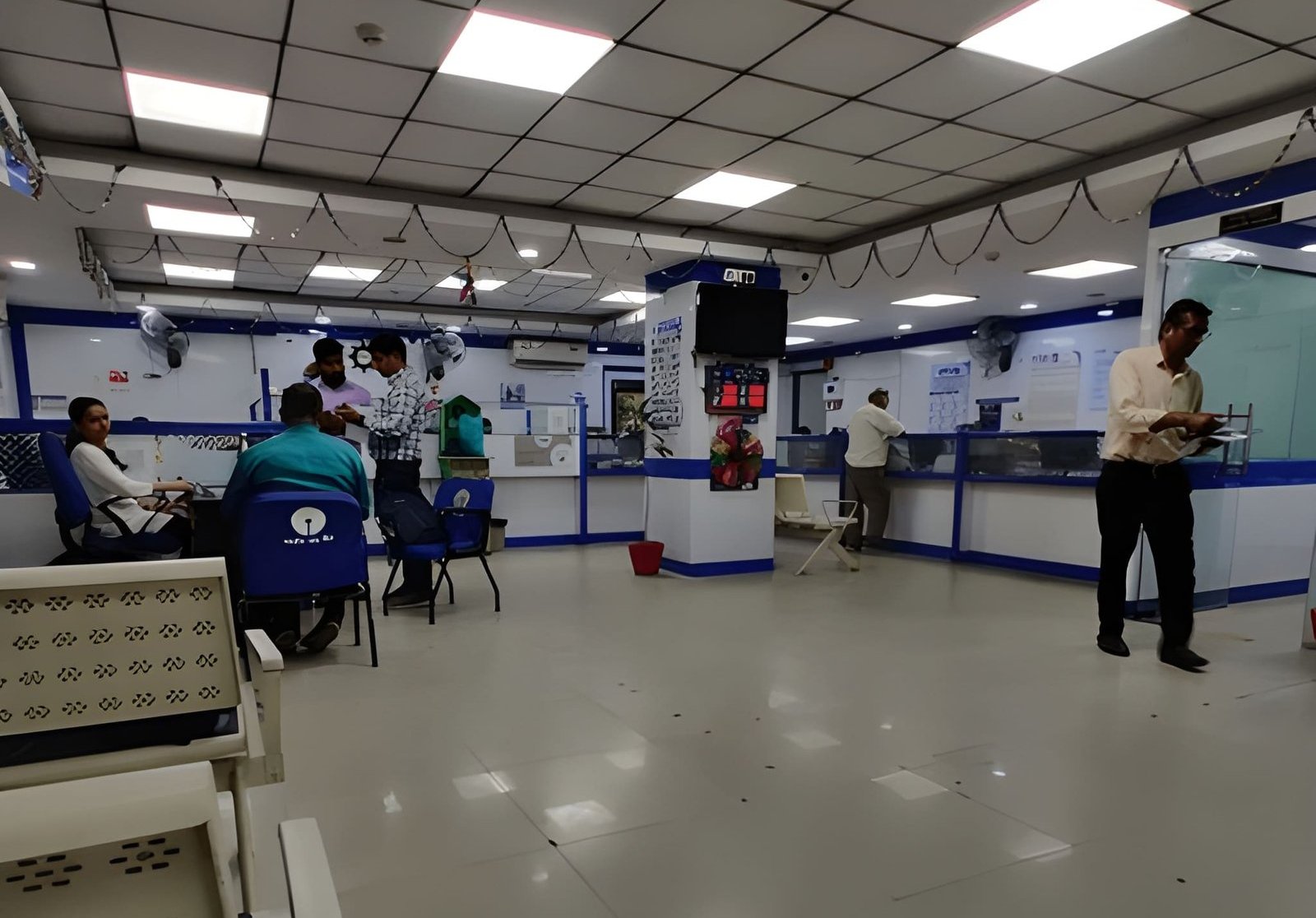
Indian banking still offers stability, but mergers, targets, and short staffing have turned it into a pressure cooker that deserves honest attention.
Ten years ago, on my first posting, my branch head handed me a target sheet on a Monday morning and told me it was non negotiable. It listed cross selling numbers for insurance, mutual funds, and a locker scheme nobody in that semi urban branch actually wanted. I remember spending the following Saturday, a day I was technically not required to work, cold calling loan customers for collections because the regional office wanted the month's numbers before the second Saturday holiday kicked in. Nobody called it overtime. It was simply the job. A decade later, colleagues tell me the target sheets have only grown longer and the Saturdays have not gotten any shorter, even as the country argues, once again, about whether bank staff deserve a five day work week.
That tension, between a profession India still associates with stability and a lived reality that looks very different on the ground, is what this piece is about.
The job India still admires, and what changed
Ask most Indian parents and a government bank job still sits near the top of the list of respectable, secure careers. That reputation was built over decades of a fairly predictable working life: fixed hours, a pension, and a clear line between office and home.
The turning point, in the experience of almost every colleague I have spoken to, was the 2019 government decision to merge ten public sector banks into four larger ones. The stated aim was efficiency and scale. What employees actually felt, in my experience and in conversation after conversation since, was the opposite of relief. Branch customer bases grew overnight, systems and processes from different banks had to be reconciled, and staffing did not expand to match the new workload.
Staff shortage is now one of the most consistent complaints I hear across public sector banks, from Kerala to Punjab. What used to be a predictable nine to five government job has, in the words of employees quoted in a 2025 ThePrint ground report on the sector, turned into something closer to a twenty four hour, always on obligation.
Inside the pressure: targets, timelines, and the always on branch
Cross selling targets are not new to banking, but the scale and style have shifted. New generation incentive schemes, with names like performer of the month, have imported a private sector sales culture into institutions that were, until recently, judged mainly on prudence rather than push. A single manager I know now tracks insurance premiums, mutual fund SIPs, credit card sign ups, and locker rentals against a personal scorecard reviewed weekly by regional office.
Technology has not made this easier. Core banking systems, WhatsApp groups for daily reporting, and video call reviews mean a branch manager is reachable well past closing time, and increasingly expected to be. In May 2024, a video from a Canara Bank review meeting went viral after a divisional manager was recorded berating branch level colleagues and telling them their families could wait. The bank distanced itself from the individual's conduct, but the clip resonated precisely because so many bankers recognised the tone from their own review calls. A similar clip involving a Bandhan Bank officer surfaced around the same time.
None of this is uniform. Conditions vary sharply by bank, by branch, by which manager you happen to report to. I have worked under managers who shielded their teams from unreasonable demands, and under others who passed every ounce of pressure downward. But the pattern, across enough branches and enough banks, is consistent enough that it cannot be waved away as a few bad apples.
What the data and research actually show
Anecdote is not evidence, so it is worth looking at what has actually been measured. A peer reviewed cross sectional study of 282 bank employees across Kollam district in Kerala, published in the Annals of Occupational and Environmental Medicine in August 2024, found that more than four in five participants showed moderate to high levels of burnout, and roughly a quarter reported stress ranging from mild to severe. Crucially, the study found that burnout and stress levels were significantly linked to how many hours employees actually worked, and the researchers concluded that regulating working hours could meaningfully improve bank employees' mental health.
This lines up with what occupational health researchers studying Indian bank staff have flagged for years: role excess, meaning simply having more work than a person can reasonably do in the hours available, role ambiguity over shifting job expectations, an eroding boundary between office and home enabled by always available technology, and strained relationships with seniors. Research in this space has also drawn a useful distinction between the public and private sector: public bank employees tend to report more stress tied to bureaucratic and political pressure, while private bank employees report more stress from the sheer volume of work itself.
When pressure turns fatal
This is the most sensitive part of the story, and it deserves to be handled as carefully as it is reported. A two part investigation by the independent outlet Article 14 cited a union estimate that work related pressure has been a factor in close to 500 bank employee deaths by suicide over roughly the past decade. The investigation drew on suicide notes and more than a hundred internal letters from staff and unions describing abusive treatment by seniors, and in some accounts, pressure to misrepresent target achievement.
Two specific cases from that reporting illustrate the pattern, and it is important to state clearly that these are documented allegations and reported claims, not medically confirmed causes of death, unless a formal inquiry says otherwise. In February 2024, a Union Bank of India chief manager posted in Junagadh, Gujarat, died by suicide, leaving behind a note that reportedly pointed to workload and workplace culture. Weeks later, a branch manager at UCO Bank in Tamil Nadu also died, in circumstances colleagues linked to work related pressure; he left behind a young daughter.
A separate wave of national attention arrived in September 2024, following the death of a young chartered accountant at EY's Pune office, whose family alleged that extreme workload contributed to her death. In the same week, an HDFC Bank employee in Lucknow collapsed and died at her desk, an incident her colleagues also linked to work pressure, though no official cause tying her death to workload has been established. The overlap of these stories briefly made overwork a national talking point, and drew criticism toward a since clarified remark by the finance minister about students needing inner strength, made in an unrelated context that many read as dismissive of the underlying issue.
I want to be honest about the limits of what any of this proves. Suicide has many causes, and it would be irresponsible, and inaccurate, to reduce a person's death to a single workplace factor. What the union letters, the notes, and the volume of similar accounts do establish is a pattern serious enough that banks and regulators should not be able to shrug it off as isolated tragedy.
The fight for a five day week
The clearest, most concrete demand on the table is the five day banking week. An understanding between the Indian Banks' Association and workmen unions in December 2023, followed by the 12th Bipartite Settlement signed on 8 March 2024, recommended declaring all Saturdays as bank holidays under the Negotiable Instruments Act, with employees agreeing to work forty extra minutes on the remaining weekdays to make up the hours. As of early 2026, that recommendation was still awaiting government and Reserve Bank of India approval.
On 27 January 2026, roughly eight lakh bank employees and officers, organised under the United Forum of Bank Unions, an umbrella of nine associations covering officers and workmen, held a nationwide one day strike specifically to press for implementation. Unions have pointed out that this is not the first time the demand has stalled after assurances; a planned strike in March 2025 was called off after the finance ministry promised the issue was receiving serious attention, and by January 2026 that promise still had not translated into action. Protests demanding action continued through the middle of 2026 in cities including Nizamabad, Shivamogga, and Jammu, with unions warning of further, potentially indefinite, strike action if the delay continues.
What would actually change this
Having sat through enough regional review calls to last a lifetime, my honest view is that a five day week alone will not fix a target culture, though it would help. A few changes would matter more than any single policy announcement:
Staffing ratios need to catch up with the workload that followed the 2019 mergers, rather than assuming digitisation alone closes the gap. Target design needs to separate genuine business goals from theatre, the kind of scorecard that exists mainly to give regional office something to shout about on a call. Manager accountability has to run in both directions, so that abusive conduct on a review call carries consequences as real as a missed sales number. And mental health support needs to mean actual, confidential, adequately staffed counselling access, not a poster in the staff room that nobody has ever called the number on.
None of this is radical. Much of it is already policy on paper at several banks. The gap is between what head office writes down and what a branch manager, three levels removed and under pressure himself, actually enforces.
A considered close
I do not want to leave the impression that Indian banking is uniformly miserable, because that would be its own kind of dishonesty. I have colleagues who have built genuinely good careers, who found managers worth learning from, and who still believe in the work a bank branch does for the ordinary people who walk in needing a loan or a locker or simply someone patient enough to explain a form. But I have also watched, over a decade, how a job built on public trust quietly absorbed a private sector intensity it was never designed to carry, without the staffing, the pay structure, or the mental health infrastructure to match. The five day week, if it finally arrives, will be a start. What happens after that, in the way targets are set and managers are held to account, is where the real change has to happen.
Sources
- Centre for Financial Accountability, on the 27 January 2026 UFBU strike
- Business Standard, on the January 2026 strike
- ThePrint, "Govt jobs are changing. PSU bank staff live in pressure cooker
- Annals of Occupational and Environmental Medicine (PMC)
- Article 14, "A Crisis In Indian Banking
- Business Today, on the Finance Minister's clarification of her remarks
- WION, on the death of an HDFC Bank employee