

Reviewed by Varun Singh, Banker · 13 years, public sector bank (IT & Administration) · Updated · Fact-checked by Varun Singh
It is 11 pm. Your phone buzzes: forty thousand rupees debited from your account. You did not make any payment. In that moment most people panic, then wait until morning. That wait can cost you the money. A UPI fraud refund depends almost entirely on how fast you act, and on knowing which rule applies at each step.
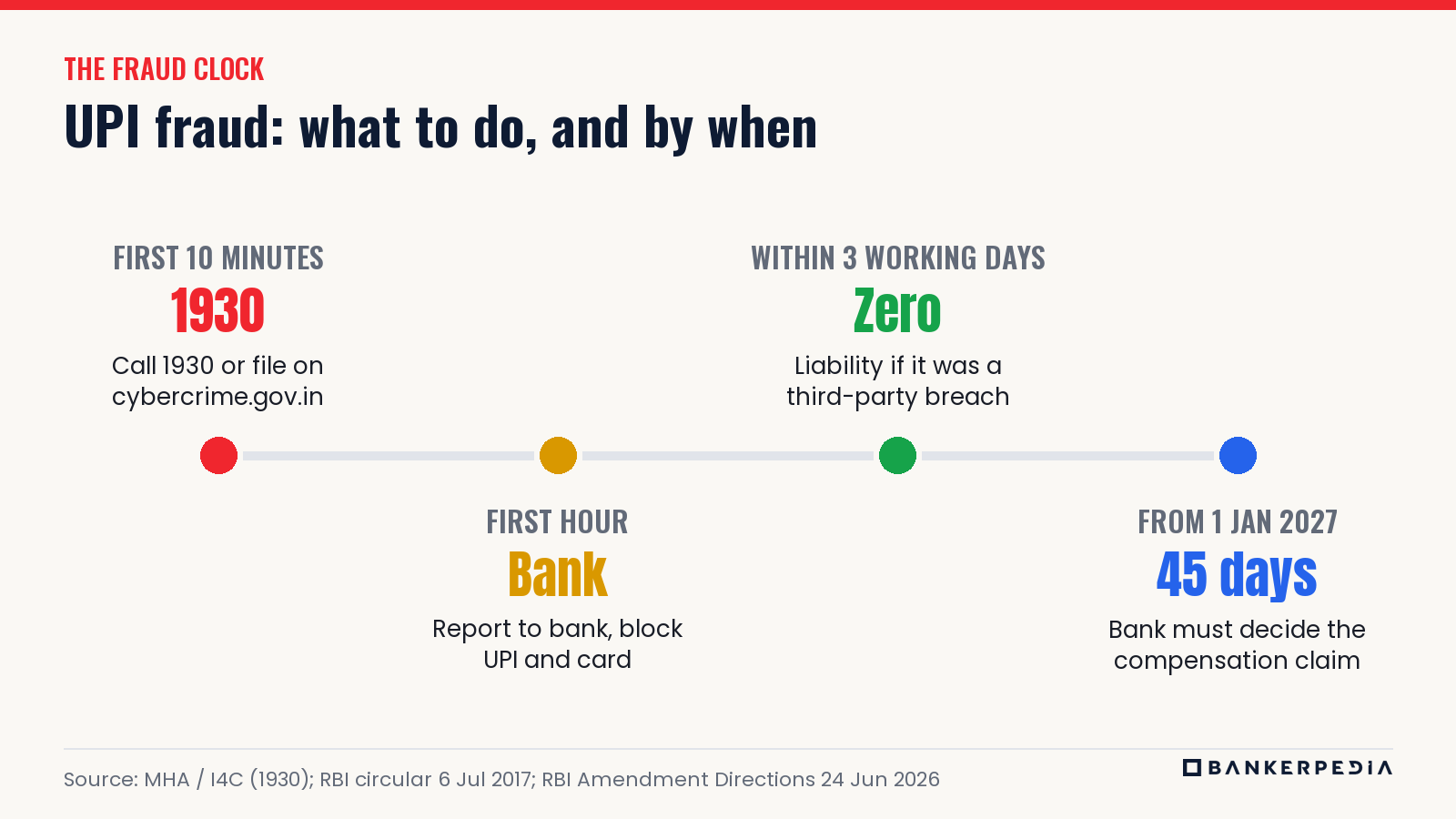
The Bankerpedia Research Wing mapped the whole journey as a clock, from the first ten minutes to 45 days [4], using RBI rules, government data and real cases. Watch the report above, or follow the steps below.

Stage 1: call 1930 right away
Call 1930, the national cyber fraud helpline, or file a complaint at cybercrime.gov.in [8]. This feeds the Citizen Financial Cyber Fraud Reporting and Management System, which alerts banks and payment apps along the money trail [7].
Why the rush? Fraudsters rarely keep stolen money in one account. They move it through "mule accounts", often opened in other people's names, and withdraw it as fast as possible. If your complaint reaches the bank before the money is withdrawn, it can put a lien (a hold) on the amount in the mule account. According to the government, this system had saved more than ₹11,158 crore by 30 June 2026 [7]. That is why the first hour after a fraud is called the golden hour.
Stage 2: the first hour, tell your bank
- Report to your bank through its helpline, app or email, and ask for a complaint number.
- Block UPI, debit card and net banking so no further money can leave.
- Save evidence: SMS alerts, screenshots of the transaction, the fraudster's number or UPI ID, and the 1930 acknowledgement.
- Do not delete chats or call logs, even if they embarrass you.
Stage 3: the three-day rule for a UPI fraud refund
This is the law today, from RBI's circular of 6 July 2017 on limiting customer liability in unauthorised electronic banking transactions [3].
| When you report a third-party fraud | Your liability |
|---|---|
| Within 3 working days | Zero [3] |
| 4 to 7 working days | Limited, ₹5,000 to ₹25,000 depending on account type [3] |
| After 7 working days | As per the bank's board-approved policy [3] |
| Fraud due to the bank's negligence | Zero, whenever reported [3] |
Where your liability is zero or limited, the bank must credit (shadow reverse) the amount within 10 working days of your report [3]. The burden of proving that you were careless lies on the bank [3]. One important exception: if you shared your OTP or PIN, the bank may hold you liable until you report it.
Stage 4: the new rule from 1 January 2027
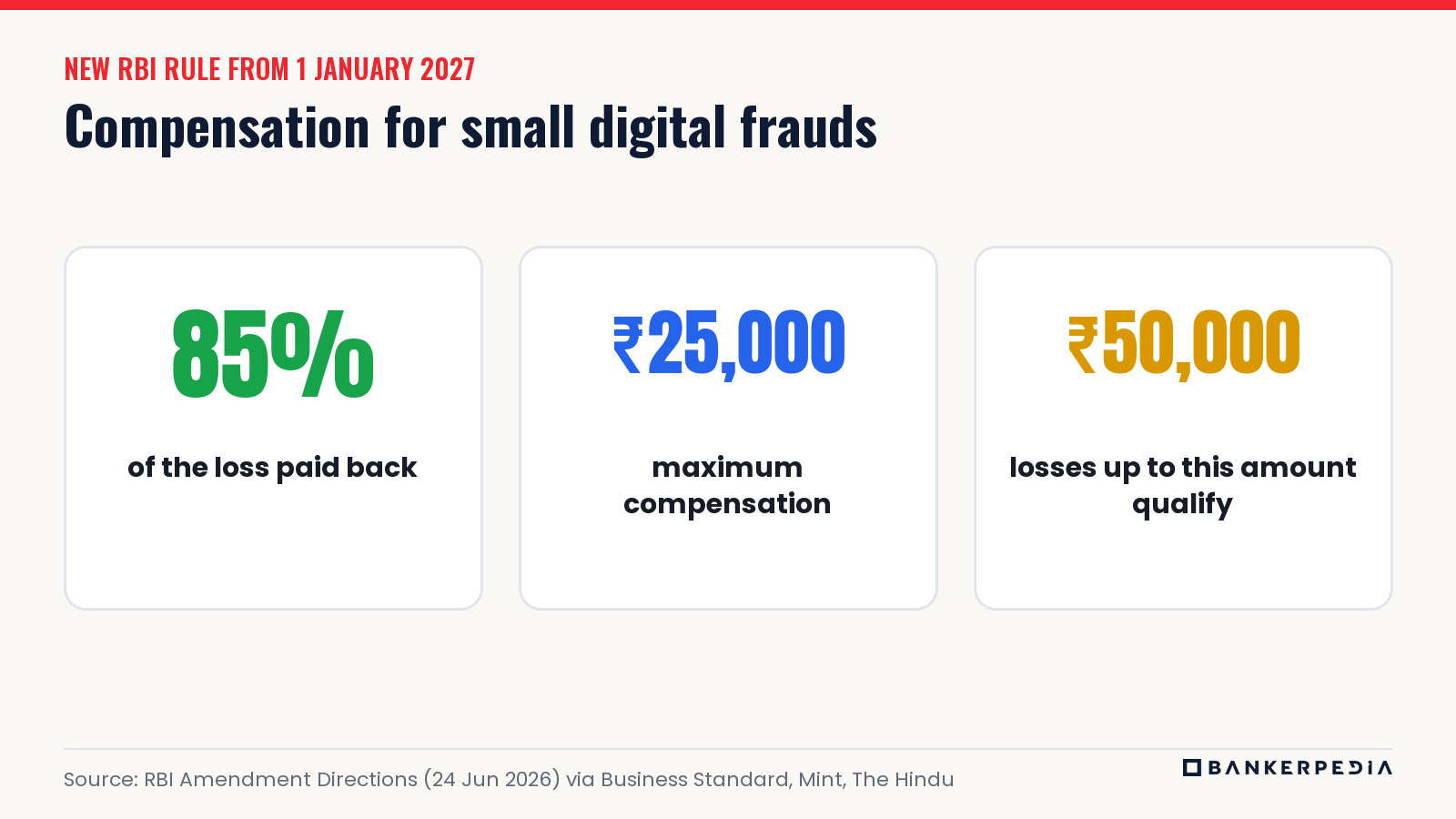
RBI has finalised a new compensation framework for small digital frauds, effective from 1 January 2027 [1][2]. It was widely reported by Business Standard, Mint and The Hindu [2][4][5].
| Your loss | Compensation |
|---|---|
| ₹20,000 [2] | ₹17,000 (85%) [2] |
| ₹40,000 [2] | ₹25,000 (capped) [2] |
| Above ₹50,000 [2] | Not covered by this scheme [2] |
Conditions apply [4]:
- It can be claimed only once in a lifetime [4].
- You must report to both the bank and 1930 within five calendar days [4].
- The bank must decide within 45 days [4].
Stage 5: from hold to refund
Here is the hard truth. A hold is not a refund.
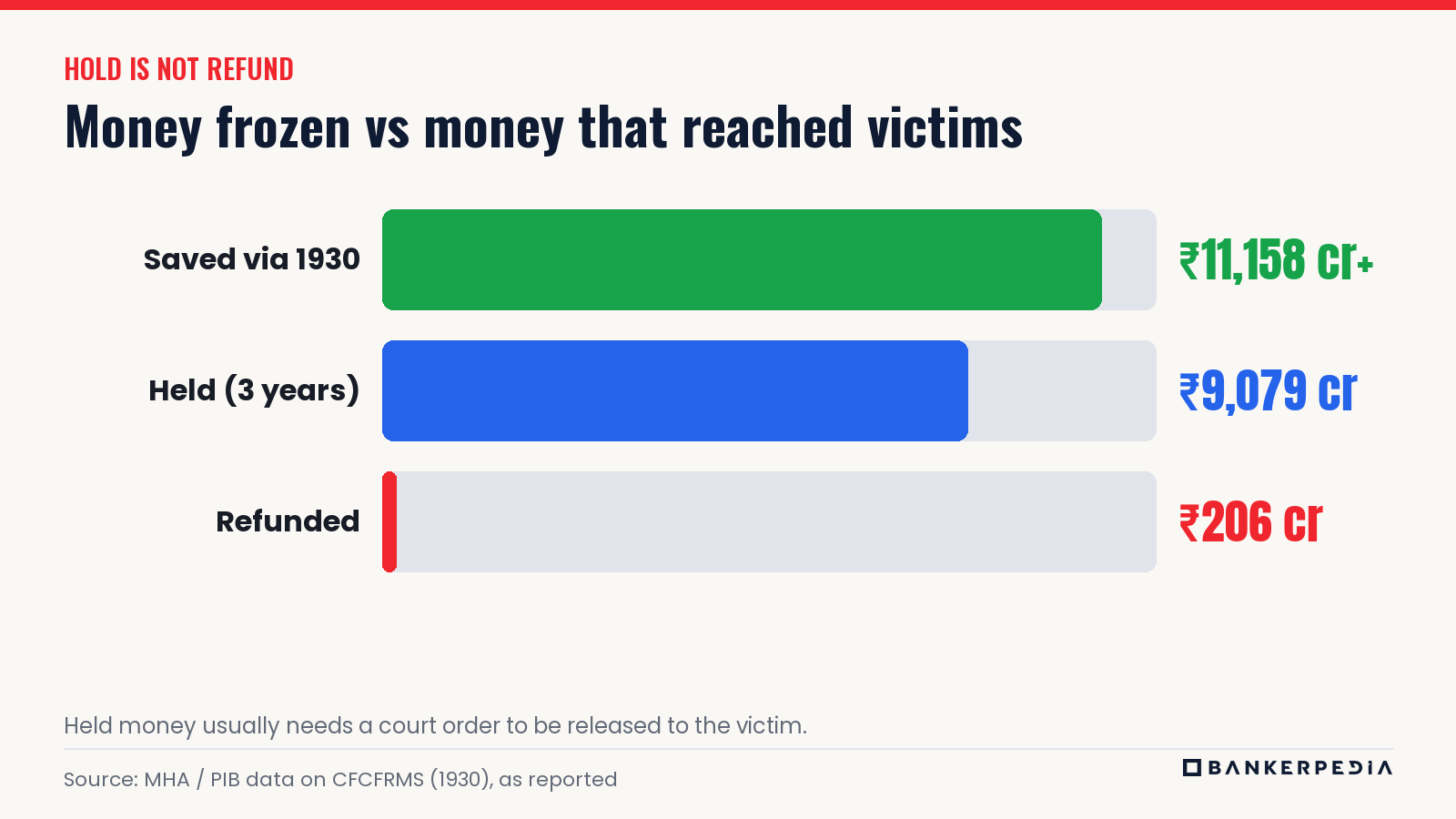
Government data shows that over three years more than ₹9,079 crore was put on hold, but only about ₹206 crore actually reached victims [7]. Money frozen in a mule account usually needs a court order to be released. Some police units do push this: Cyberabad police returned more than ₹25 crore to victims through court orders in 2026 [6]. Keep following up with your local cyber cell and ask specifically about the refund process.
Stage 6: when the bank does not listen, the RBI Ombudsman
If the bank rejects your complaint, does not reply, or you are not satisfied, file with the RBI Ombudsman at cms.rbi.org.in [9]. It is free and needs no lawyer. Attach your bank complaint, the 1930 acknowledgement and your evidence. Use Bankerpedia Bank Complaint AI to draft a clear complaint letter.
How UPI frauds usually happen
Knowing the common tricks helps you spot one before you lose money. Most UPI frauds need you to do something: approve a request, enter your PIN, or share a code.
- Collect requests disguised as payments. A "buyer" sends a request and asks you to enter your PIN to "receive" money. Entering your UPI PIN always sends money; it never receives it.
- Screen-sharing apps. A fake customer-care agent asks you to install an app, then watches your screen as you type.
- Fake KYC or electricity bill messages that push you to call a number or click a link.
- "Digital arrest" calls where fraudsters pose as police or officials and pressure you to transfer money. No real agency arrests anyone over a video call.
Remember the clock
- 10 minutes: 1930 or cybercrime.gov.in [8].
- 1 hour: bank report, block UPI and cards, save evidence [7].
- 3 working days: written complaint to the bank for zero liability [3].
- 5 calendar days: report to both bank and 1930 to qualify for the 2027 compensation [4].
- 45 days: the bank's deadline to decide under the new rule [4]. After that, the Ombudsman.
Our take
The system now has real tools for victims: 1930, the three-day rule and the new compensation scheme. But they all reward speed. Save 1930 in your phone today, keep SMS alerts on, and tell your parents what to do before they ever need it.
How did your bank handle your complaint? Share your experience on Bankerpedia 30, where customers rate India's top 30 banks so others can choose the right one. All sources are on Bankerpedia Explore.
Video transcript
Read the full transcript
Questions people ask
How do I get my money back after a UPI fraud?
Call 1930 or file on cybercrime.gov.in immediately, report the fraud to your bank in writing and block UPI and cards, keep screenshots and the complaint number, and follow up. If the bank does not resolve it, complain to the RBI Ombudsman at cms.rbi.org.in.
Is there a time limit to report UPI fraud?
Yes. Under RBI's 2017 rules, if a third-party fraud is reported within three working days, your liability is zero. Reporting in four to seven working days limits your liability to between ₹5,000 and ₹25,000 depending on the account. Later reports are handled as per the bank's board-approved policy.
What is the new RBI fraud compensation rule from 2027?
From 1 January 2027, victims of digital fraud with losses up to ₹50,000 can get 85% of the loss, up to ₹25,000. It is available once in a lifetime, the fraud must be reported to the bank and to 1930 within five calendar days, and the bank must decide within 45 days.
What does 1930 do?
1930 is the helpline of the Citizen Financial Cyber Fraud Reporting and Management System. It alerts banks and payment apps so that money moving through mule accounts can be put on hold before it is withdrawn.
Why is my money on hold but not refunded?
Money frozen in a fraudster's account usually needs a court order or a police process to be released back to the victim. Follow up with the cyber cell and ask about the refund procedure.
Sources
- RBI press release on amendment directions for limiting customer liability (2026)Primary source
- Business Standard: RBI finalises fraud compensation framework for victims of digital fraud (24 Jun 2026)
- RBI: Customer Protection, Limiting Liability of Customers in Unauthorised Electronic Banking Transactions (6 Jul 2017)Primary source
- Mint: RBI digital fraud new rules from Jan 1, 2027, how much compensation can you claim (31 Oct 2026)
- The Hindu: RBI's digital scam compensation pilot, explained (25 Jun 2026)
- The Hindu: Cyberabad Police refund over ₹25 crore to cyber fraud victims so far this year (21 Jul 2026)
- PIB / MHA: Citizen Financial Cyber Fraud Reporting and Management System (1930) dataPrimary source
- National Cyber Crime Reporting PortalPrimary source
- RBI Complaint Management System (Ombudsman)Primary source
- The Hindu: RBI proposes to compensate customers up to ₹25,000 loss due to fraud
Priya Srivastava is the Editor of Bankerpedia, where she oversees the accuracy, clarity, and editorial standards of its banking education content. She works with practising bankers to ensure every article reflects current RBI regulations, real banking practice, and the needs of exam aspirants and working professionals.
Varun Singh checked every number against its source on 28 Nov 2026. 10 sources, 5 from official sites. Read our editorial policy.
This page explains how things work. It is not personal investment, tax or legal advice. Rules change: we re-check this page against its sources and date every update. Spotted something wrong? Tell our corrections desk.
Forward this before a scammer calls them.
Scammers go after parents and grandparents first. One forward can stop a loss.
Send on WhatsAppBe one of the first to share this