

Reviewed by Varun Singh, Banker · 13 years, public sector bank (IT & Administration) · Updated · Fact-checked by Varun Singh
You went to the branch to renew a fixed deposit. You came back with an insurance policy. If that has happened to you or your parents, you are not alone. In FY 2024-25, the insurance regulator IRDAI recorded 26,667 complaints about unfair business practices, 14% more than the year before [8]. Much of this insurance mis-selling happens across bank counters.
Why does your banker push policies? The Bankerpedia Research Wing followed the money: from your premium, to the insurer, to the bank's commission, to the target that reaches the branch. We also explain RBI's new rules that start on 1 January 2027 [1]. Watch the report above, or read on.

What happens at the counter
The pattern is familiar. A customer, often a senior citizen, comes to renew an FD. The staff suggest a "better plan" that supposedly "pays more than an FD". The words insurance, lock-in and surrender charges are said quietly or not at all. The customer signs.
The government knows this happens. In March 2024 the Department of Financial Services asked public sector banks to check mis-selling, after finding cases where life insurance was sold even to people above 75 years of age [5].
Follow the money
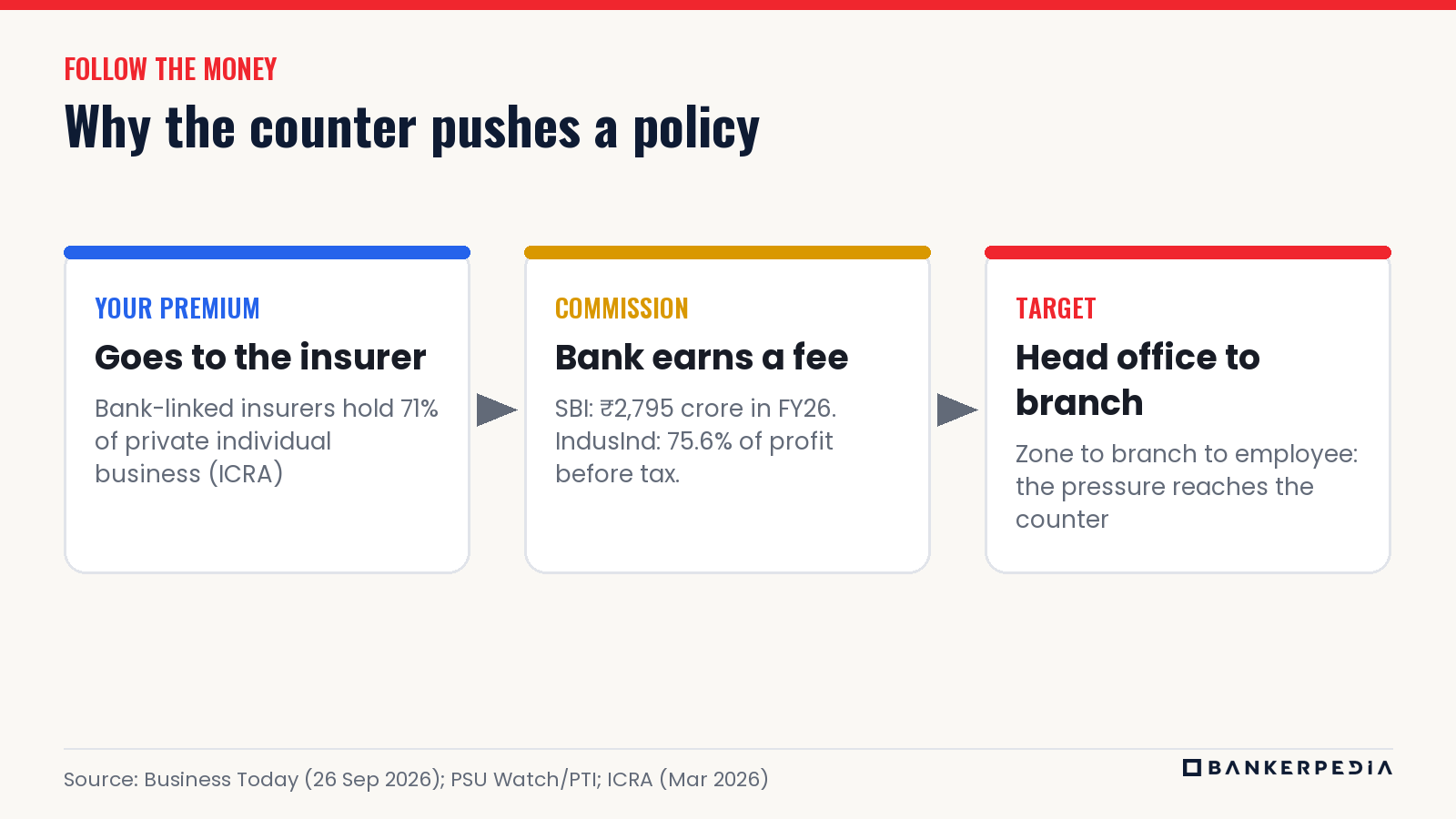
Banks sell insurance as corporate agents and earn a commission on every policy. For many banks, that income is large [6][7]:
| Bank or market | Insurance income figure |
|---|---|
| SBI, FY26 | ₹2,795 crore from insurance commission [7] |
| IndusInd Bank | Insurance commission equal to 75.6% of profit before tax [6] |
| Bank-linked insurers | 71% of private insurers' individual business (ICRA) [4] |
When a business earns that much from one product, sales targets follow. Targets travel from the head office to zones, from zones to branches, and from branches to individual employees. A clerk who also has to open accounts, pass loans and answer complaints is expected to sell a fixed number of policies every quarter. That pressure is where mis-selling begins.
Who loses?
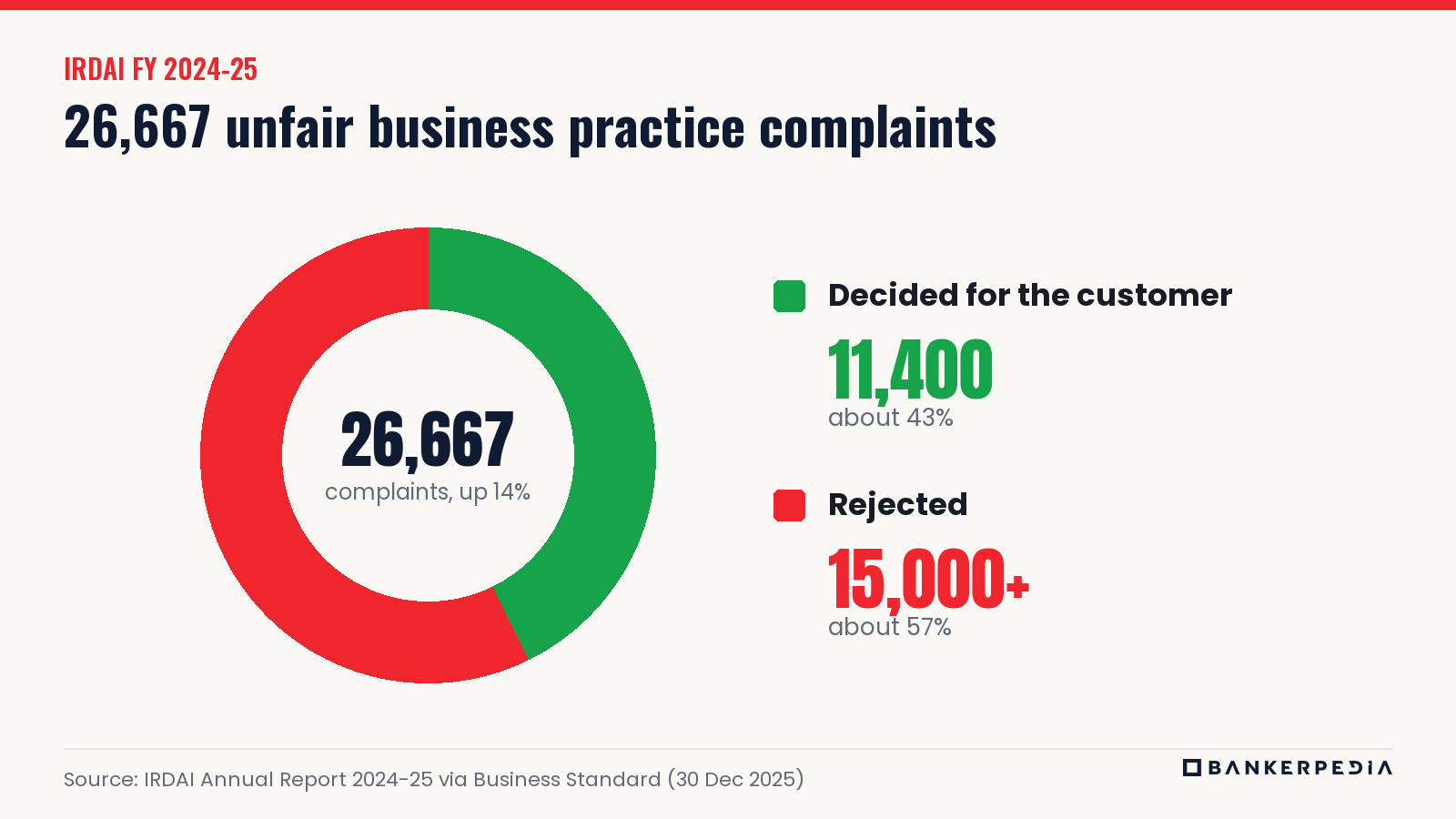
Of the 26,667 unfair business practice complaints, about 11,400 were decided in the customer's favour; more than 15,000 were rejected [8]. Many customers cannot prove what was said at the counter, because they signed the forms. The money lost is often savings meant for a medical emergency or a daughter's wedding, locked into a policy with high early surrender charges.
The new rules against insurance mis-selling from 1 January 2027
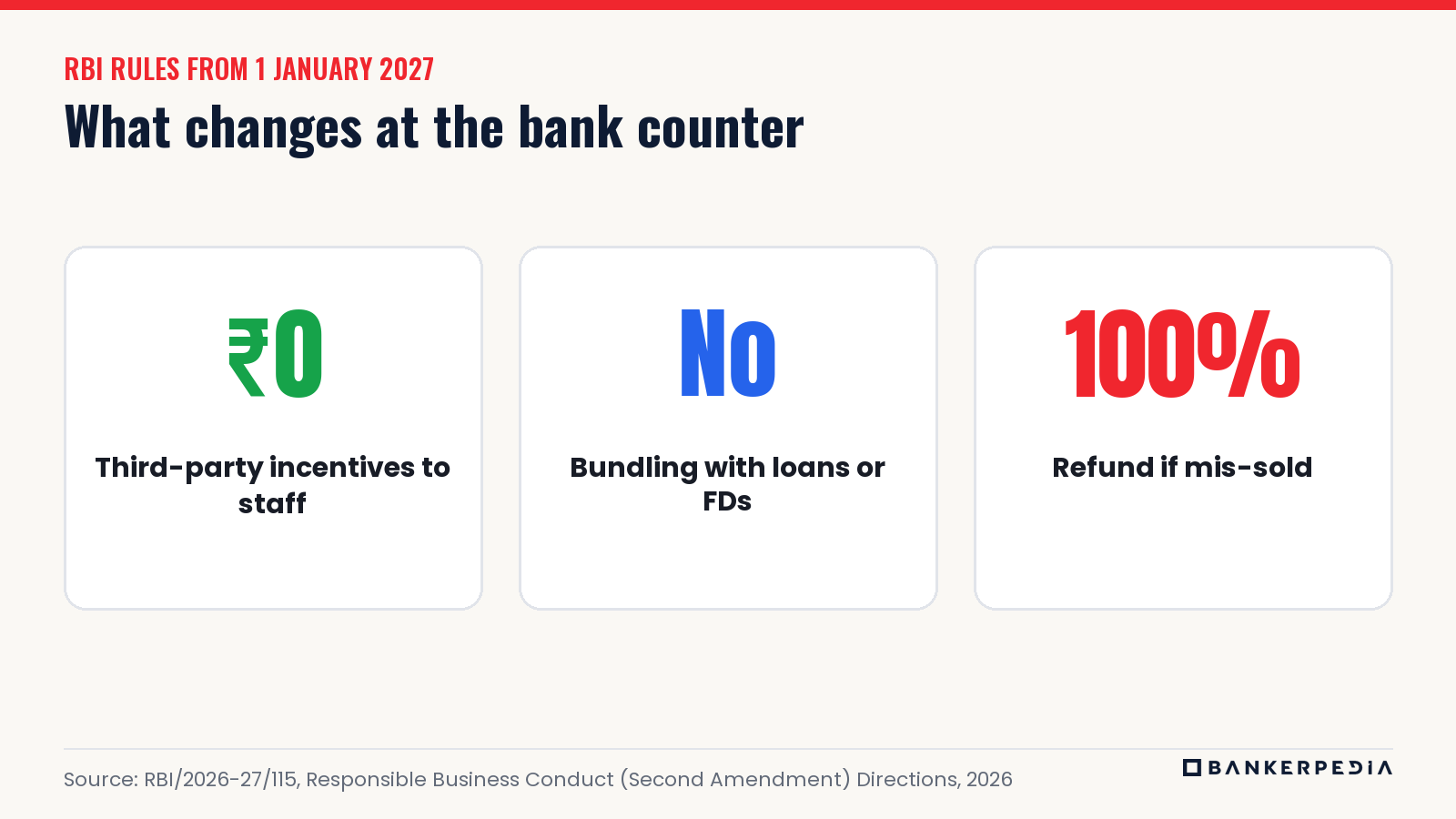
In 2026, RBI amended its Responsible Business Conduct Directions to tackle mis-selling of third-party products like insurance and mutual funds [1][9]. From 1 January 2027 [1]:
- No incentives to staff from third parties. Bank employees cannot be paid incentives by the insurer for selling its products [1].
- No bundling. A bank cannot make buying insurance a condition for a loan, FD, locker or any other service [1].
- Default is "No". Optional products must not be pre-selected on forms; the customer must actively choose them [1].
- Suitability. The product must suit the customer's needs and profile [1].
- Full refund. If mis-selling is established, the bank must refund the full amount paid [1].
Your five weapons
- Ask "Is this insurance?" before you sign anything presented as a deposit or plan. Ask for the policy brochure and the benefit illustration.
- Use the free look period. You have 30 days from receiving the policy document to return it and get your premium back, minus small deductions [3].
- Say no to bundling. If a loan or locker is linked to buying a policy, refuse and cite RBI's rules [1].
- Complain in writing. Write to the bank and the insurer. Then use IRDAI's Bima Bharosa portal or the Insurance Ombudsman [10].
- Escalate the bank's conduct. If the bank does not resolve the complaint about its staff's conduct, go to the RBI Ombudsman at cms.rbi.org.in.
Need help writing the complaint? Bankerpedia Bank Complaint AI drafts a clear letter from a few answers.
Questions to ask before you buy any policy at a bank
A good policy can be useful. The problem is buying the wrong one without knowing it. Before you sign, ask these questions and get the answers in writing:
- Is this an insurance policy or a deposit? Which company issues it?
- How many years must I pay premiums, and what is the lock-in?
- What do I get back if I stop after one, two or three years? Ask for the surrender value table.
- Is the return assured? If yes, exactly how much, and is it written in the policy document?
- Does the bank earn a commission on this sale?
If the staff cannot answer clearly, or ask you to sign first and read later, walk away. A genuine product will still be available after you take a day to think and discuss it with your family.
Protect your parents
Senior citizens are the most common targets, because they visit branches more and trust the staff. Sit with your parents and check their FD receipts and any "plans" they have bought in the last year. If something was sold as an FD but is actually a policy, and it is within the free look period [3], return it. If not, start the complaint process now.
Our take
Most bankers do not want to mis-sell. Many are pushed by targets they did not set. RBI's new rules attack the root of the problem: the incentive. Until they take effect and are enforced, the best protection is a customer who asks one simple question: "Is this insurance?"
Share your experience with your bank on Bankerpedia 30, where customers rate India's top 30 banks so others can choose the right one. Spotted a scam? Check and report it on Bankerpedia Scams.
Video transcript
Read the full transcript
Questions people ask
Why do bank employees sell insurance?
Banks act as corporate agents for insurers and earn commission on every policy. In FY26, SBI earned ₹2,795 crore from insurance commission. Targets set by head offices flow down to zones, branches and individual employees.
What is insurance mis-selling?
Selling a policy that does not suit you, or selling it with wrong or missing information: for example, calling a policy an FD, hiding charges, or making it a condition for a loan or locker.
What are RBI's new rules on mis-selling from 1 January 2027?
Banks cannot pay staff incentives from third-party product sellers, cannot bundle a third-party product as a condition for a loan or deposit, must keep the default answer as 'No' for add-on products, and must refund the full amount if mis-selling is proven.
Can I cancel an insurance policy I was mis-sold?
Yes. You have a free look period of 30 days from receiving the policy document to return it for a refund of premium, minus small deductions. After that, complain to the insurer, then on IRDAI's Bima Bharosa portal or to the Insurance Ombudsman.
Where do I complain about insurance mis-selling by a bank?
Complain in writing to the bank and the insurer. If not resolved, use IRDAI's Bima Bharosa portal or the Insurance Ombudsman; for the bank's conduct, you can also go to the RBI Ombudsman at cms.rbi.org.in.
Sources
- RBI/2026-27/115: Responsible Business Conduct (Second Amendment) Directions, 2026Primary source
- IRDAI: Annual Report 2024-25Primary source
- IRDAI: Protection of Policyholders' Interests Regulations, 2024Primary source
- ICRA: Life insurance research (Mar 2026)
- DT Next / PTI: Check mis-selling, safeguard account holders' interest, DFS tells banks (18 Mar 2024)
- Business Today: How much are your banks dependent on insurance commissions? (26 Sep 2026)
- PSU Watch / PTI: Insurance distribution boosts fee income at most public sector banks in FY26
- Business Standard: Misselling in insurance sector a significant concern, IRDAI annual report (30 Dec 2025)
- Business Today: How RBI plans to stop product mis-selling by lenders (16 Jun 2026)
- IRDAI Bima Bharosa grievance portalPrimary source
Priya Srivastava is the Editor of Bankerpedia, where she oversees the accuracy, clarity, and editorial standards of its banking education content. She works with practising bankers to ensure every article reflects current RBI regulations, real banking practice, and the needs of exam aspirants and working professionals.
Varun Singh checked every number against its source on 28 Nov 2026. 10 sources, 4 from official sites. Read our editorial policy.
This page explains how things work. It is not personal investment, tax or legal advice. Rules change: we re-check this page against its sources and date every update. Spotted something wrong? Tell our corrections desk.
Someone you know is stuck with a bank complaint. Send them this.
Most people do not know they can complain for free.
Send on WhatsAppBe one of the first to share this