


Reviewed by Varun Singh, Banker · 13 years, public sector bank (IT & Administration) · Updated · Fact-checked by Varun Singh
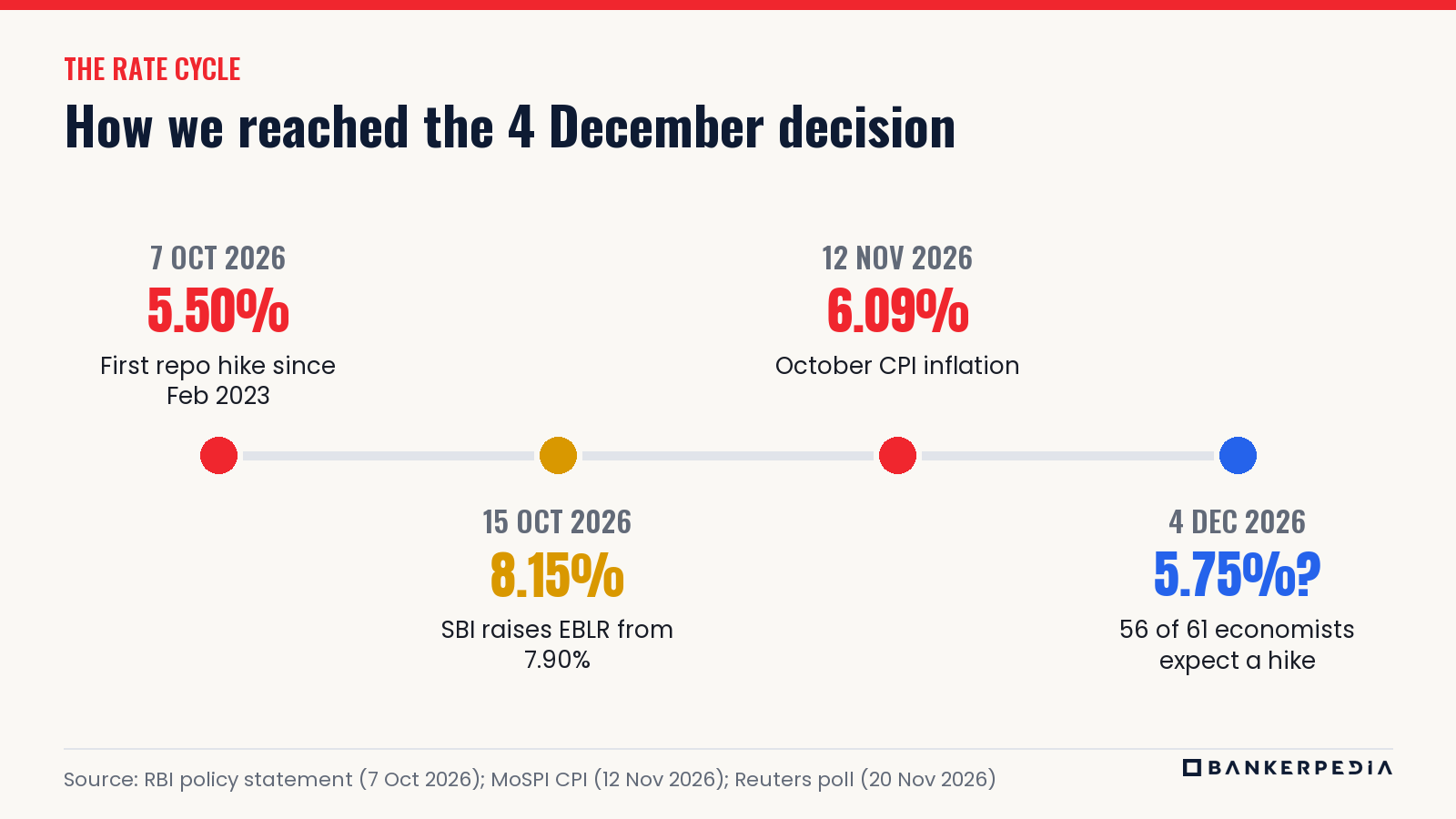
On 4 December 2026, the Reserve Bank of India will announce its next policy decision. In a Reuters poll taken between 13 and 20 November, 56 of 61 economists said they expect RBI to raise the repo rate again, from 5.50% to 5.75% [1]. If you have a floating rate home loan, that decision lands directly on your EMI, or quietly on your loan tenure.
How much will it cost you, and what can you do before 4 December? The Bankerpedia Research Wing ran the numbers on a real ₹50 lakh home loan [6]. Watch the full report above, or read on.

What has happened so far
After cutting rates through 2025, RBI changed direction. On 7 October 2026, the Monetary Policy Committee raised the repo rate by 25 basis points to 5.50%, its first hike since February 2023 [2]. RBI projected CPI inflation at 6.0% for the October-December quarter [2].
Banks moved quickly. SBI raised its external benchmark lending rate (EBLR) from 7.90% to 8.15% and its repo-linked lending rate (RLLR) from 7.50% to 7.75%, effective 15 October [4][5].
The pressure: inflation above the band
October's consumer price inflation came in at 6.09%, above the upper end of RBI's 2 to 6% tolerance band [3]. Food inflation was 8.94% [3]. When inflation stays above the band, RBI is expected to act. That is why most economists now expect another hike [1].
Not everyone agrees on the size. Some forecasters, including SBI Research, have argued for a bigger move. Others say a stronger rupee could slow RBI down. These are forecasts, not decisions.
Repo rate hike and your home loan EMI: three scenarios
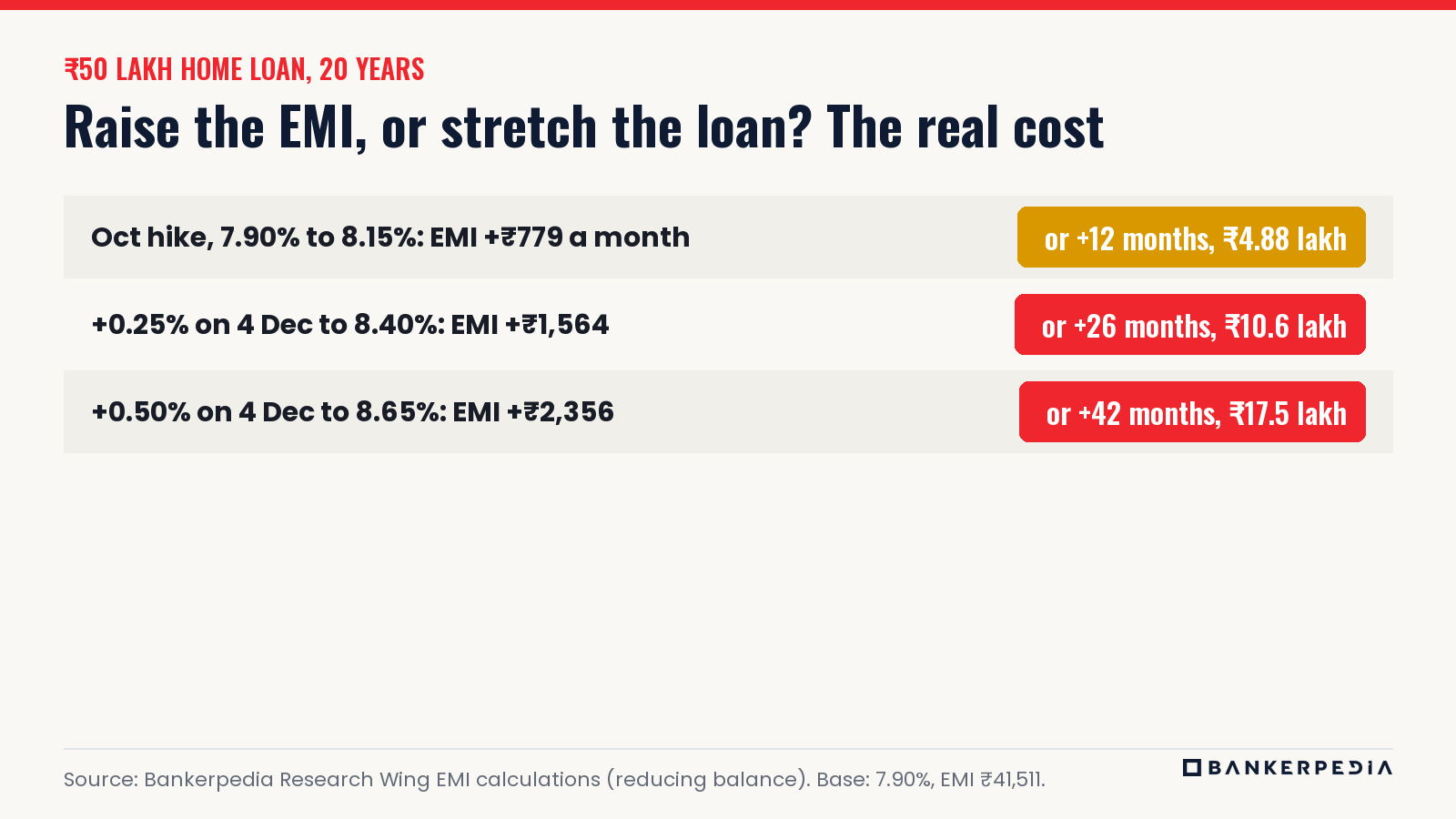
The Research Wing used a standard reducing-balance EMI calculation [6]. Loan: ₹50 lakh for 20 years [6]. Before October, at 7.90%, the EMI was ₹41,511 [6].
| Scenario | Rate | Option A: higher EMI | Option B: same EMI, longer loan |
|---|---|---|---|
| October hike (already happened) | 8.15% [4] | +₹779 a month [6] | +12 months, ₹4.88 lakh extra interest [6] |
| +0.25% on 4 Dec [6] | 8.40% [6] | +₹1,564 a month [6] | +26 months, ₹10.6 lakh extra interest [6] |
| +0.50% on 4 Dec [6] | 8.65% [6] | +₹2,356 a month [6] | +42 months, ₹17.5 lakh extra interest [6] |
Look at the difference. The higher EMI feels painful every month. But the longer tenure quietly costs several times more in total interest [6]. And many banks, by default, keep the EMI fixed and extend the tenure. During the 2022 hiking cycle, Business Standard reported borrowers who took 20-year loans ending up with 24 years of EMIs [9].
Your rights under RBI rules
RBI's Responsible Business Conduct Directions, 2025 protect floating rate borrowers [10]:
- You choose. At reset, the bank must let you choose between a higher EMI, a longer tenure, or a mix of both [10][7].
- You are told. The bank must inform you of the change promptly and send a quarterly statement [10].
- No endless stretching. Tenure cannot be extended so far that the EMI does not even cover the interest [10].
- No prepayment charge. On floating rate loans to individuals for non-business purposes, sanctioned or renewed on or after 1 January 2026, banks cannot charge for prepayment [10].
Home loans linked to an external benchmark such as the repo rate must be reset at least once every three months [8], so a December hike would reach your loan within a quarter.
How a repo rate change reaches your loan
Since October 2019, new floating rate retail loans from banks must be linked to an external benchmark, usually the repo rate [8]. Your loan rate is the benchmark plus a spread that the bank fixes when you take the loan. When RBI raises the repo rate, your rate rises by the same amount at the next reset, which must happen at least once every three months [8].
Older loans linked to MCLR or base rate also move, but more slowly and not always by the full amount. If you are still on MCLR or base rate, compare your rate with what new borrowers get. Switching to a repo-linked loan, or moving to another bank, can sometimes save more than any prepayment.
What about fixed deposits?
If you are a saver rather than a borrower, there is some good news. Reports in October noted that large banks had not yet raised their FD rates. If rates keep rising, new FDs may offer better rates. But the rate on an existing FD does not change until it matures.
Three things to do before 4 December
- Check your remaining tenure in your bank's app or latest statement. If it has grown since you took the loan, the bank has been extending it.
- Write to your bank saying that at the next reset you want the EMI raised, not the tenure [10].
- Keep a prepayment ready. A bonus or savings used to prepay cuts interest directly, and on most floating rate home loans there is no charge [10].
Run your own numbers on the Bankerpedia EMI calculator.
Our take
You cannot change what RBI decides on 4 December. But you can decide how your loan absorbs it. Do not fear a quarter-point hike. Fear a tenure that grows without anyone asking you.
Before you take or switch a loan, see how real customers rate their banks on Bankerpedia 30, and add your own experience so others can choose well. After the 4 December decision, the Research Wing will publish an update. All sources are on Bankerpedia Explore.
Video transcript
Read the full transcript
Questions people ask
What is the current repo rate in India?
RBI raised the repo rate by 25 basis points to 5.50% on 7 October 2026, its first hike since February 2023. The next decision is due on 4 December 2026.
Will the repo rate increase in December 2026?
In a Reuters poll of 61 economists conducted from 13 to 20 November 2026, 56 expected a 25 bps hike to 5.75%. SBI Research has called for a 50 bps hike. These are forecasts; RBI's decision may differ.
How much will my EMI rise if the repo rate goes up?
On a ₹50 lakh, 20-year loan whose rate went from 7.90% to 8.15% in October, the EMI rises by ₹779 a month. If the rate rises a further 0.25% to 8.40%, the EMI is ₹1,564 higher than at 7.90%; at 8.65% it is ₹2,356 higher.
Is it better to increase EMI or tenure after a rate hike?
Increasing the EMI costs far less overall. On a ₹50 lakh loan, keeping the EMI fixed after the October hike stretches the loan by 12 months and costs ₹4.88 lakh in extra interest. RBI rules let you choose.
Can my bank increase my loan tenure without asking?
No. Under RBI's directions, at reset the bank must give you the option to raise the EMI, extend the tenure, or combine both, and must inform you and send quarterly statements. Tenure cannot be extended so far that the EMI no longer covers interest.
Sources
- Reuters poll: India's RBI expected to raise rates in December (20 Nov 2026)
- RBI: Monetary Policy Statement (7 Oct 2026)Primary source
- MoSPI: CPI press release for October 2026 (12 Nov 2026)Primary source
- ETV Bharat: SBI hikes EBLR, RLLR and MCLR from October 15 (16 Oct 2026)
- State Bank of India: Interest rates on loans
- Bankerpedia Research Wing: EMI scenarios (reducing balance method)
- RBI: Reset of floating interest rate on EMI based personal loans (18 Aug 2023)Primary source
- RBI: External benchmark based lending (4 Sep 2019)Primary source
- Business Standard: Loan for 20 years, EMIs for 24 (6 Oct 2022)
- RBI (Commercial Banks, Responsible Business Conduct) Directions, 2025, paras 349-353Primary source
Priya Srivastava is the Editor of Bankerpedia, where she oversees the accuracy, clarity, and editorial standards of its banking education content. She works with practising bankers to ensure every article reflects current RBI regulations, real banking practice, and the needs of exam aspirants and working professionals.
Varun Singh checked every number against its source on 28 Nov 2026. 10 sources, 5 from official sites. Read our editorial policy.
This page explains how things work. It is not personal investment, tax or legal advice. Rules change: we re-check this page against its sources and date every update. Spotted something wrong? Tell our corrections desk.
Know someone paying an EMI? Send them this.
A five-minute read can change what they ask their bank.
Send on WhatsAppBe one of the first to share this