

Reviewed by Varun Singh, Banker · 13 years, public sector bank (IT & Administration) · Updated · Fact-checked by Varun Singh
Your salary, your savings, your fixed deposits: they all sit in a bank. So how safe is that bank? Asking for the safest bank in India is natural, but there is no official ranking. What exists are three public numbers that every bank must report each quarter, and a government insurance scheme that sits underneath them.
The Bankerpedia Research Wing checked the latest numbers of India's 20 biggest banks, as of 30 September 2026, and built a two-minute test you can run on your own bank today. Watch the report above, or read on.

The first safety net: DICGC deposit insurance
Before any ratio, know this. The Deposit Insurance and Credit Guarantee Corporation (DICGC), a subsidiary of RBI, insures every depositor up to ₹5 lakh per bank, covering both principal and interest [1].
- It covers savings, current, fixed and recurring deposits [1].
- The limit is per depositor, per bank. Accounts in different branches of the same bank are added together [1].
- Money in two different banks is insured separately, up to ₹5 lakh in each [1].
If your deposits in one bank are below ₹5 lakh [1], the question of that bank's safety matters much less to you. Above that, the health of the bank matters.
Number one: capital (CRAR)
The capital to risk-weighted assets ratio (CRAR) tells you how much of its own money a bank has to absorb losses if some loans go bad. Think of it as a cushion. RBI requires banks to keep at least 11.5%, including the conservation buffer [13].
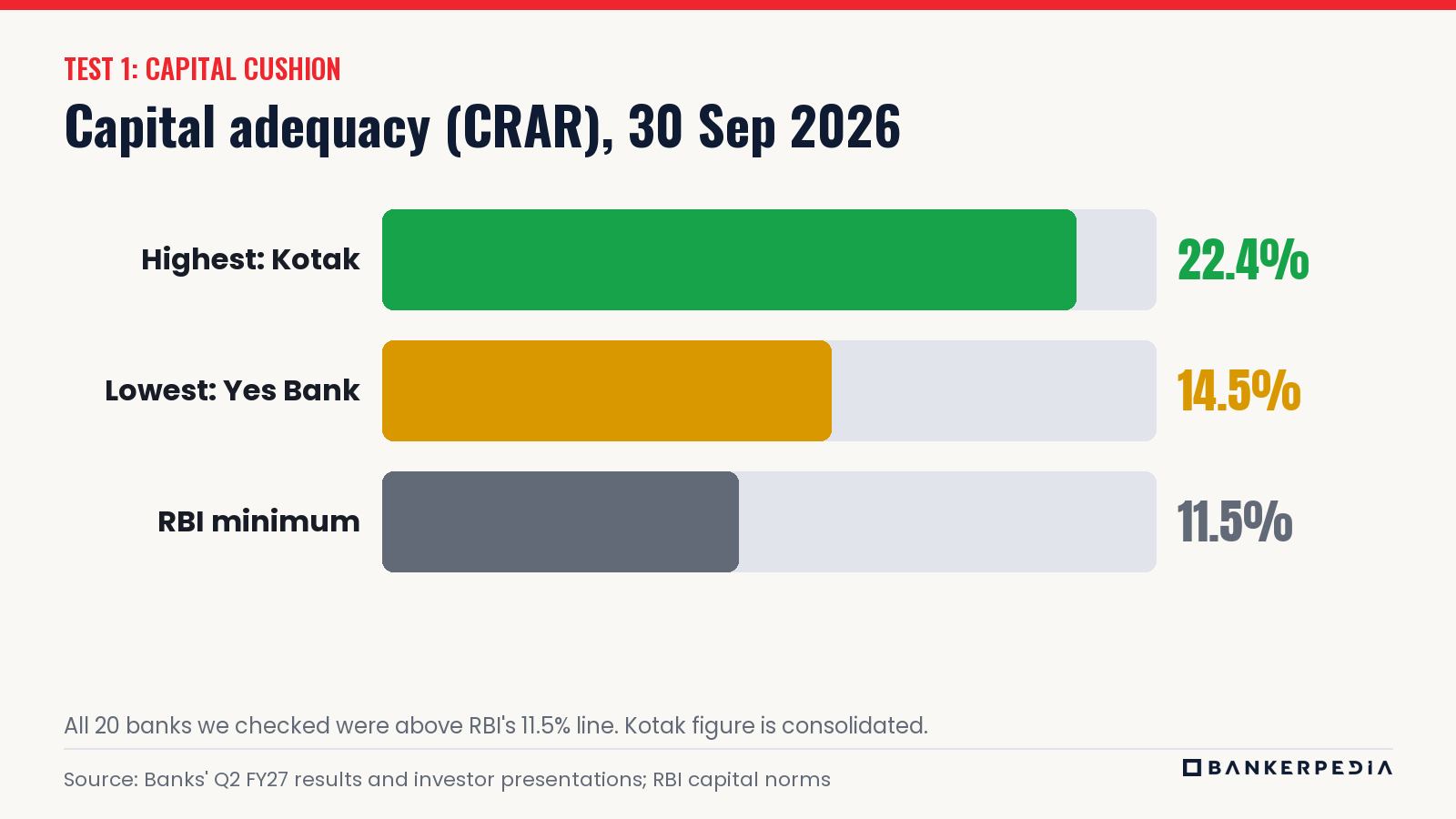
All 20 banks we checked were above that line [13]. The highest was Kotak Mahindra Bank at 22.4% (consolidated) [9]. The lowest was Yes Bank at 14.5% [12], still three points above the minimum.
Numbers two and three: bad loans (gross and net NPA)
A cushion can wear thin quickly if loans go bad. That is what NPAs (non-performing assets) measure.
- Gross NPA is the share of loans that have stopped paying.
- Net NPA is what remains after the bank has set aside money (provisions) for those losses.
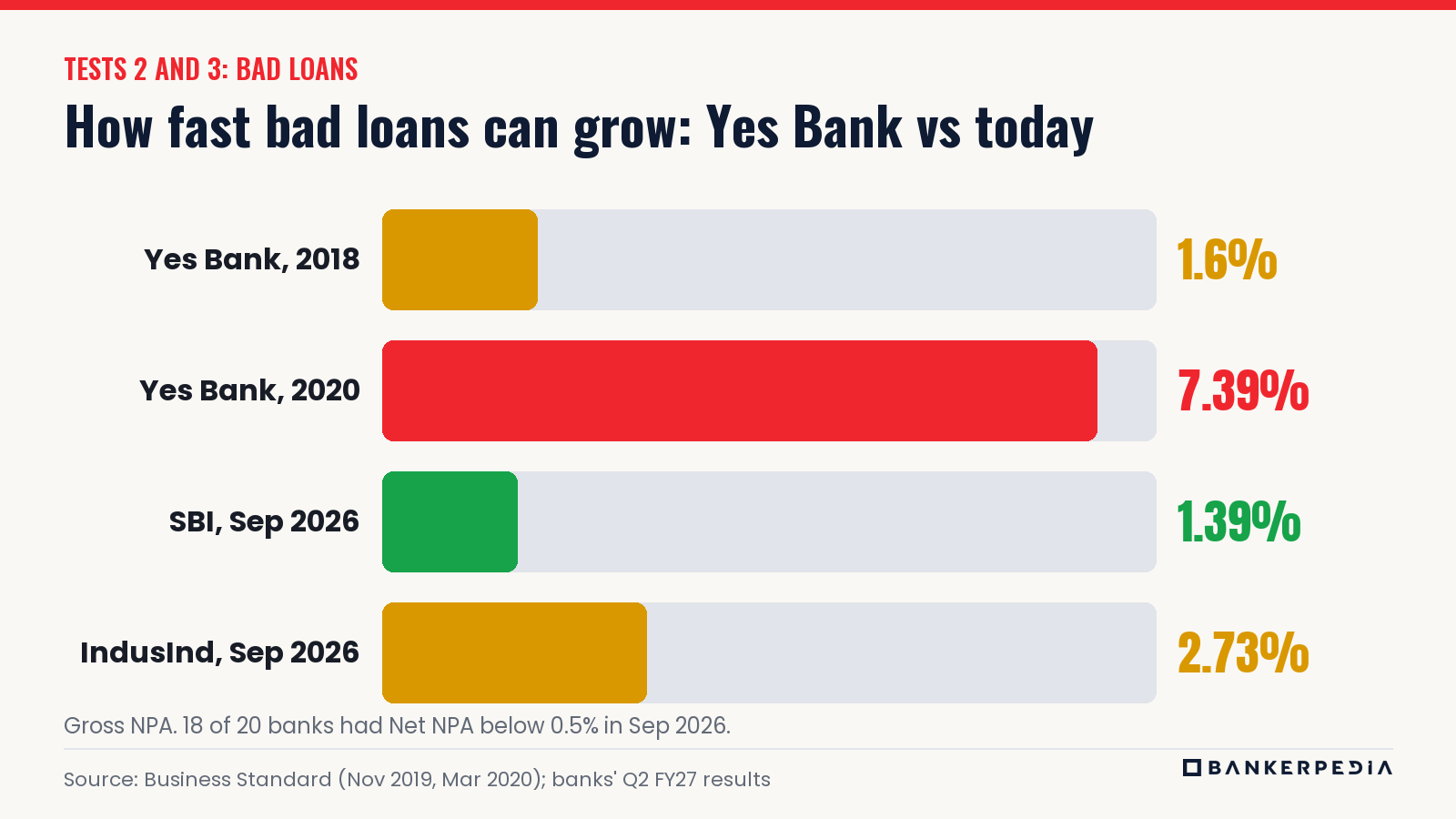
Indian banks are in their cleanest shape in years [5]. SBI's gross NPA fell to 1.39%, its lowest in two decades [11]. The highest among the 20 was IndusInd Bank at 2.73% [10]. On net NPA, 18 of the 20 banks were below 0.5% [13].
What Yes Bank teaches
The level of NPAs matters less than how fast they change. Yes Bank is the clearest Indian example. Its gross NPA was about 1.6% in 2018 [8]. By the September 2019 quarter, bad loans had spiked and the bank posted a loss; gross NPA reached 7.39% [8]. In March 2020, RBI superseded the board and capped withdrawals at ₹50,000 per account for about two weeks [7].
Depositors did not lose their money: a rescue plan led by SBI restored the bank. But for two weeks, families could not pay hospital bills or school fees from their own savings. The warning sign, a rapid jump in bad loans, was visible in the quarterly results long before.
Too big to fail: the D-SIB list
RBI identifies banks whose failure would hurt the whole economy as domestic systemically important banks (D-SIBs). The 2025 list has three names: SBI, HDFC Bank and ICICI Bank [2]. They must hold extra capital, and are watched more closely. Being on the list is not a guarantee, but it signals how seriously the regulator treats these banks.
The safest bank in India: our 20-bank scorecard
| Test | Our line | Why |
|---|---|---|
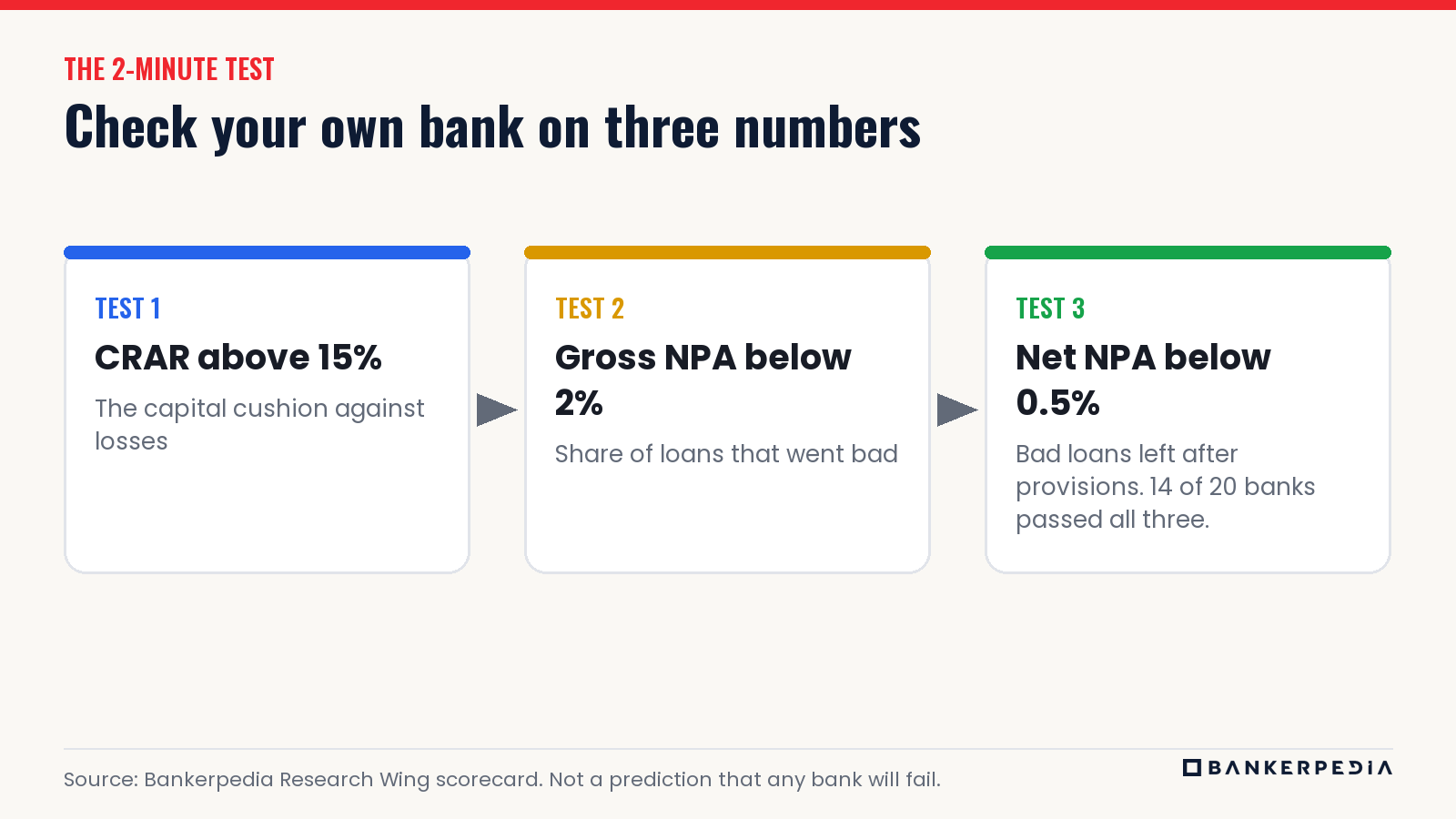
| CRAR | Above 15% [13] | A cushion well above RBI's 11.5% minimum [13] |
| Gross NPA | Below 2% [13] | Few loans gone bad |
| Net NPA | Below 0.5% [13] | Losses already provided for |
| Result (20 banks, Sep 2026) | Number of banks |
|---|---|
| Passed all three tests | 14 [13] |
| Passed two | 4 [13] |
| Passed one | 2 [13] |
This scorecard is not a prediction that any bank will fail. All 20 banks are above RBI's minimum requirements [13]. It simply shows where the cushion is thickest. Bank-wise data and source links for all 20 banks are on Bankerpedia Explore, built from the banks' own results such as ICICI Bank's and Canara Bank's September 2026 disclosures [3][4] and PNB's results [6].
Your 2-minute test
- Search for your bank's latest quarterly results or investor presentation.
- Write down three numbers: CRAR, gross NPA and net NPA.
- Compare them with our lines: above 15%, below 2% and below 0.5% [13].
- Check the trend. If gross NPA has jumped sharply over two or three quarters, as it did at Yes Bank [8], be careful.
- Keep deposits within ₹5 lakh per bank [1] if you want full insurance cover, and spread large savings across two or three strong banks.
Our take
Indian banks are healthier today than at any time in the last two decades. For most people, the real risk is not the bank failing; it is keeping everything in one place without knowing the numbers. Spend two minutes a year on these three ratios, and spread large deposits sensibly.
Numbers tell half the story; service tells the rest. See which banks real customers trust on Bankerpedia 30, India's 30 top-rated banks rated by actual customers, and add your own experience so others can choose well. Facing an unfair charge? Use Bankerpedia Bank Complaint AI.
Video transcript
Read the full transcript
Questions people ask
Which is the safest bank in India?
There is no single official safest bank. RBI's list of domestic systemically important banks (D-SIBs) has SBI, HDFC Bank and ICICI Bank, which face extra capital requirements because of their size. In our scorecard of 20 big banks, 14 passed all three tests: CRAR above 15%, gross NPA below 2% and net NPA below 0.5%.
How much of my deposit is insured in India?
DICGC insures each depositor up to ₹5 lakh per bank, including principal and interest. Deposits in different banks are insured separately; deposits in different branches of the same bank are added together.
What is CRAR and why does it matter?
CRAR, or capital to risk-weighted assets ratio, shows how much of its own capital a bank has to absorb losses. RBI requires at least 11.5% including buffers. A higher CRAR means a thicker cushion.
What is a good NPA level for a bank?
Lower is better. In September 2026, 18 of the 20 banks we checked had net NPA below 0.5%. SBI's gross NPA of 1.39% was its lowest in two decades. Watch for a fast rise more than the level itself.
What happened to Yes Bank depositors in 2020?
Yes Bank's gross NPA rose from about 1.6% in 2018 to 7.39% in 2019. In March 2020 RBI superseded its board and set a ₹50,000 withdrawal limit for about two weeks. Deposits were protected through a rescue plan.
Sources
- DICGC: Deposit insurance of ₹5 lakh per depositor per bankPrimary source
- RBI D-SIB list 2025 (SBI, HDFC Bank, ICICI Bank), via Angel One
- ICICI Bank: Performance review, quarter ended 30 Sep 2026Primary source
- Canara Bank: Investor presentation, Sep 2026Primary source
- Business Standard: Clean books, thin margins, the new reality of Indian banking (15 Nov 2026)
- Business Today: PNB Q2 earnings, net profit rises 13%, asset quality improves (16 Oct 2026)
- Business Standard: RBI supersedes Yes Bank board, sets ₹50,000 withdrawal limit (6 Mar 2020)
- Business Standard: Yes Bank posts net loss in Sept quarter as bad loans spike (1 Nov 2019)
- Kotak Mahindra Bank Q2 FY27 results analysis (Finology)
- IndusInd Bank Q2 results: gross NPA improves to 2.73% (PSU Connect)
- SBI Q2 FY27 results (DSIJ)
- Yes Bank Q2 FY27 results (Lapaas Voice)
- Bankerpedia Research Wing: 20-bank scorecard and method
Priya Srivastava is the Editor of Bankerpedia, where she oversees the accuracy, clarity, and editorial standards of its banking education content. She works with practising bankers to ensure every article reflects current RBI regulations, real banking practice, and the needs of exam aspirants and working professionals.
Varun Singh checked every number against its source on 28 Nov 2026. 13 sources, 3 from official sites. Read our editorial policy.
This page explains how things work. It is not personal investment, tax or legal advice. Rules change: we re-check this page against its sources and date every update. Spotted something wrong? Tell our corrections desk.
Your parents keep FDs. Send them this.
Most families never check how much of their deposit is insured.
Send on WhatsAppBe one of the first to share this