


Reviewed by Varun Singh, Banker · 13 years, public sector bank (IT & Administration) · Updated · Fact-checked by Varun Singh
On the first day of work, a government bank officer earns almost twice as much as a private bank trainee. So why do thousands of graduates choose private banks every year? The honest answer to the PSU vs private bank salary question depends on two things: how fast your pay grows, and whether you stay in the job long enough for that growth to matter.
The Bankerpedia Research Wing compared official pay rules, FY26 bank data and real job listings, and then ran a 30-year earnings race between three bankers from the same batch. Watch the full report above, or read the numbers below.

PSU vs private bank salary on day one
Pay in public sector banks is fixed for the whole industry by the Bipartite Settlement signed between the Indian Banks' Association and the unions. The 12th settlement, signed on 8 March 2024, gave a 17% hike from November 2022 [1][2].
For a new Scale I officer (the post you get through SBI PO or IBPS PO), the monthly pay looks like this [1][3]:
| Component | Amount or rate |
|---|---|
| Basic pay (Scale I starting) | ₹48,480 [1] |
| Dearness allowance (Nov 2026 to Jan 2027) | 31.33% of basic [3] |
| Special allowance | 26.5% of basic [1] |
| House rent allowance | Depends on city [1] |
| Approximate gross | About ₹85,000 a month, ₹10.25 lakh a year [1][3] |
The private bank offer
Private banks do not publish pay scales. Every bank, role and city has its own offer. Job listings still give a fair picture: one 2026 listing for a large private bank's PO programme offered a starting CTC of ₹5 to 5.5 lakh a year [11].
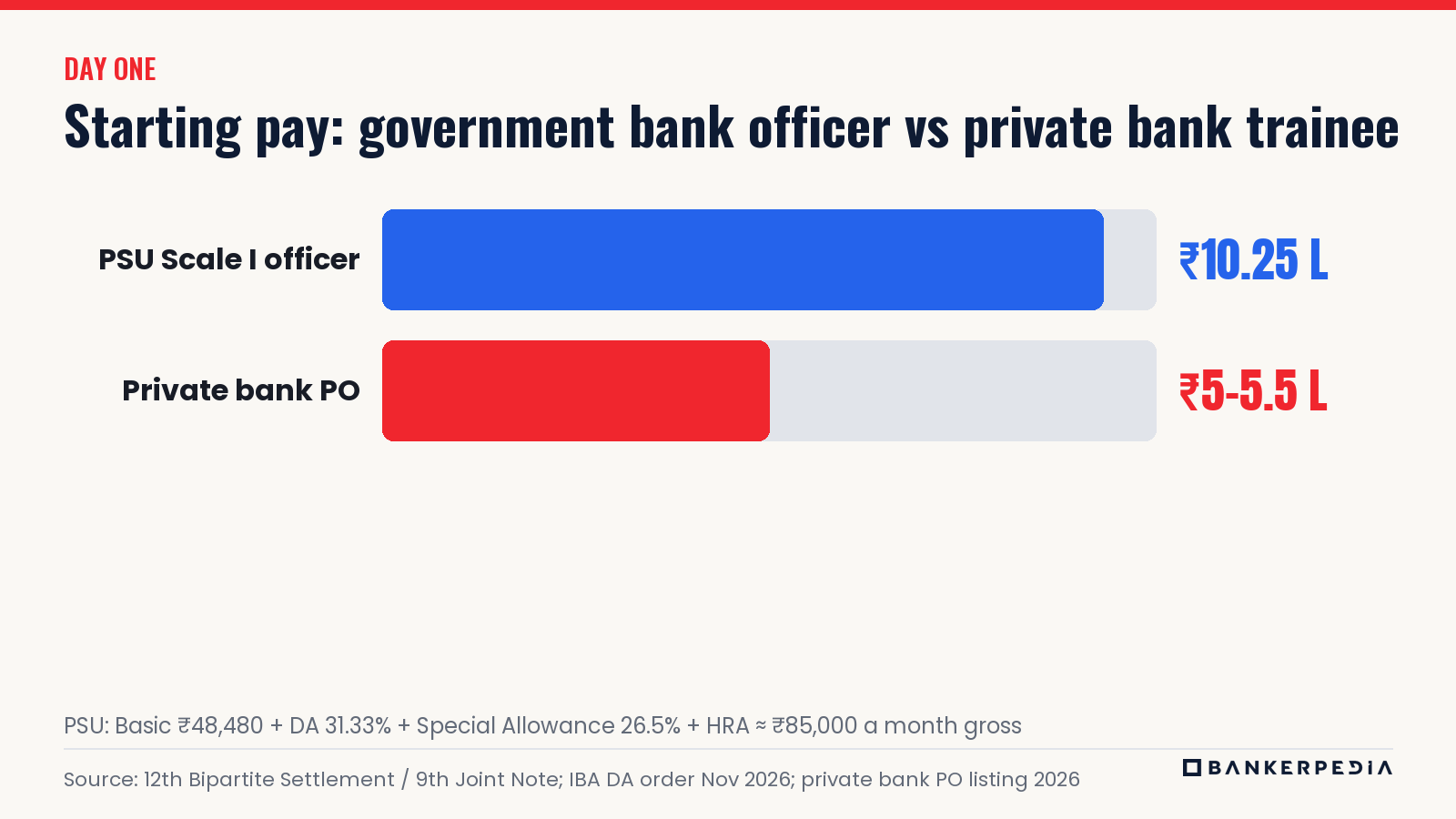
So what pulls people towards private banks? Speed. In a PSU bank, salary grows on a fixed track: an annual increment, DA revised every quarter, a new wage settlement roughly every five years, and promotion exams. The settlement also gives two extra increments on passing CAIIB [1]. In a private bank, pay grows through appraisals, variable pay and fast promotions. Do well and you jump. Stay average and you crawl.
The 30-year race
To compare the two paths fairly, the Research Wing modelled three bankers from the same batch. These are assumptions, not promises, and you can change them to test your own case:
- PSU officer: starts at ₹10.25 lakh, grows about 8% a year on average [9].
- Average private banker: starts at ₹5.5 lakh, grows 9% a year [9].
- Star private banker: starts at ₹5.5 lakh, on the fast track, grows 14% a year [9].
| Checkpoint | PSU officer | Star private banker | Average private banker |
|---|---|---|---|
| Yearly pay after 10 years [9] | About ₹20 lakh [9] | About ₹18 lakh [9] | About ₹12 lakh [9] |
| Year salary is overtaken [9] | - | Year 13 [9] | Never [9] |
| Year total earnings are overtaken [9] | - | Year 19 [9] | Never [9] |
| Total in 30 years [9] | About ₹11.5 crore [9] | About ₹19.5 crore [9] | About ₹7.5 crore [9] |
Figures in this table are Bankerpedia Research Wing model outputs based on the assumptions above.
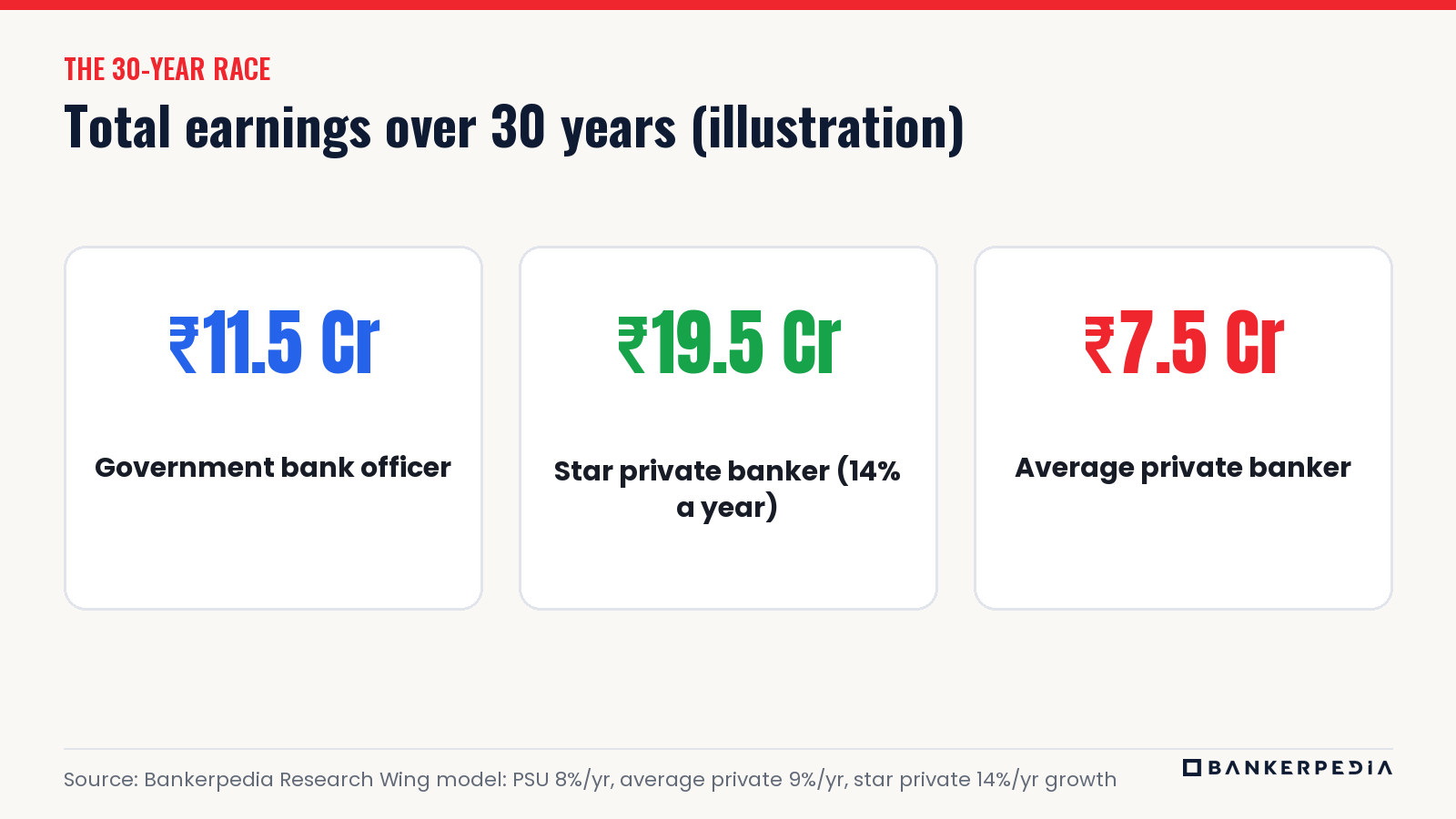
The private bank wins only if you are a star and stay one. That is where the real story lies.
The condition nobody mentions: staying
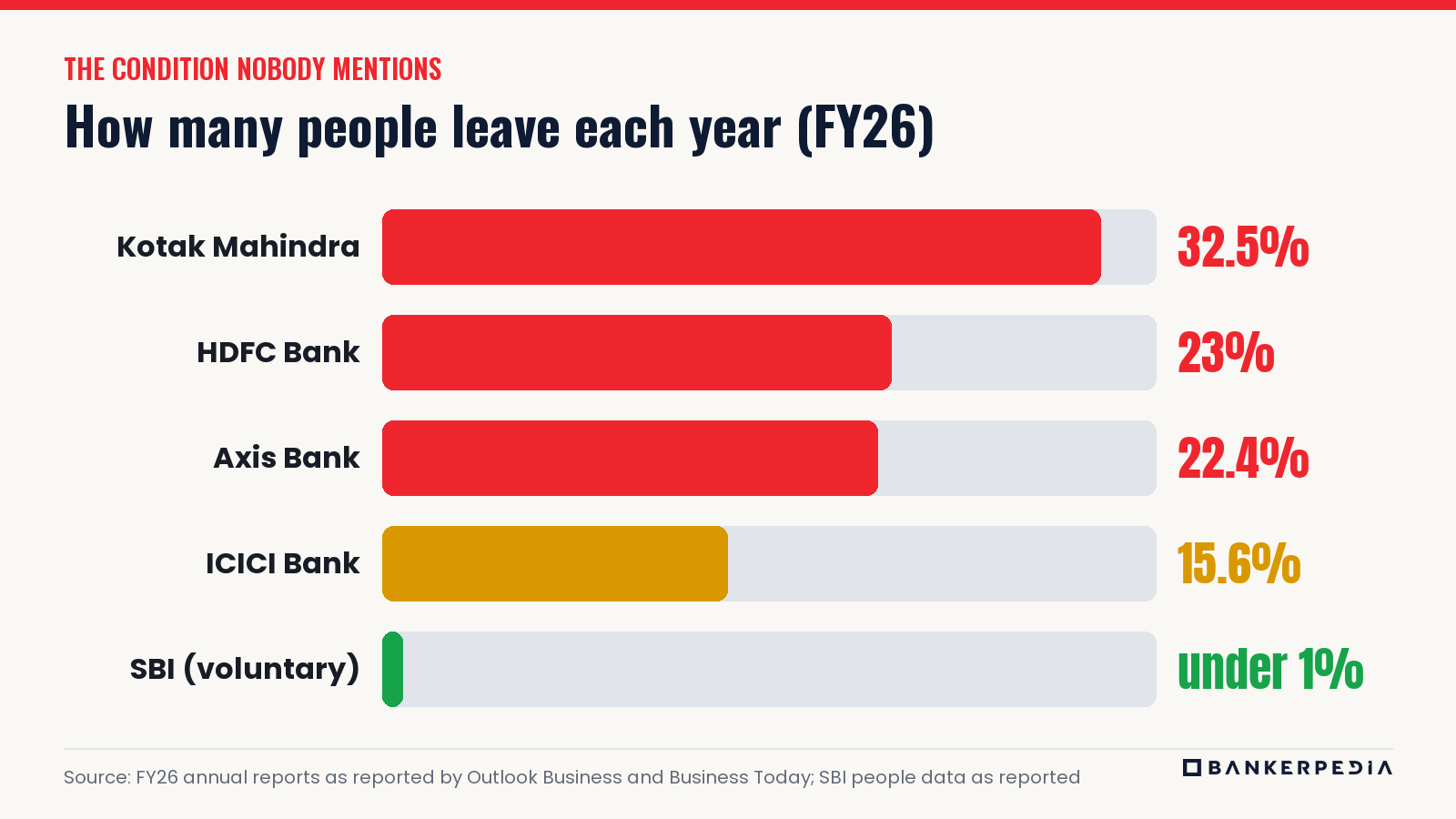
A 24-year-old IIT Delhi graduate left a banking job paying about ₹17 lakh a year [12]. News reports said the reasons were overtime, working on holidays and no time even for lunch [12]. It is one person's story, but the data says it is not unusual.
| Bank | FY26 attrition (reported) |
|---|---|
| Kotak Mahindra Bank | 32.5% [4] |
| HDFC Bank | 23% [4] |
| Axis Bank | 22.4% [4] |
| ICICI Bank | 15.6% [5] |
| SBI (voluntary turnover) | Under 1% [6] |
The star path in our model assumes 30 years of 14% growth without a break [9]. People who switch, burn out or take a gap lose that compounding. The PSU path is slower but very hard to fall off.
After sixty: retirement benefits
Retirement changes the picture again. In public sector banks, employees who joined after 2010 are on the National Pension System, and the bank contributes 14% of basic pay plus DA [1]. In most private banks the main retirement benefit is EPF, with the employer contributing 12% of basic pay [10]. Over 30 years, the higher PSU contribution builds a meaningfully larger retirement fund on the same salary [9].
Public sector banks are also on strong financial footing today. They reported a record net profit of ₹1.98 lakh crore in FY 2025-26 [8], which supports job security and the next wage revision.
Which should you choose?
- Choose PSU if you want a high, predictable start, transfers you can plan around, strong retirement benefits and a lower risk of losing your job.
- Choose private if you are confident you will be a top performer, you want fast promotions, and you can handle targets and long hours for years.
- Either way, pass JAIIB and CAIIB early. In PSU banks they add increments; in private banks they strengthen your profile.
Our take
The day-one salary is the least important number in this comparison. What matters is how long you stay and how fast you grow. For most people, the PSU path pays more over a full career. The private path pays more only for the few who stay stars for three decades.
Already working in a bank? Share your experience as a customer on Bankerpedia 30 so others can choose the right bank. Preparing for bank exams? Get every new opening on Bankerpedia Vacancy Alert, and see all our data on Bankerpedia Explore.
Video transcript
Read the full transcript
Questions people ask
What is the starting salary of a PSU bank officer in 2026?
A Scale I officer (SBI PO or IBPS PO) starts on a basic pay of ₹48,480 under the 12th Bipartite Settlement. With dearness allowance, special allowance and HRA, gross pay is roughly ₹85,000 a month, or about ₹10.25 lakh a year. The exact figure depends on the city and the latest DA rate.
Do private banks pay more than PSU banks?
Not at the start. A large private bank's PO programme listed in 2026 offered ₹5 to 5.5 lakh a year. Private pay can grow faster through appraisals, variable pay and quick promotions, so top performers can overtake PSU officers later in their career.
When does a private banker overtake a PSU officer?
In the Bankerpedia Research Wing model, a star private banker growing 14% a year passes the PSU officer's yearly salary in year 13 and total earnings in year 19. An average private banker growing 9% a year stays behind for all 30 years. These are illustrations based on stated assumptions, not guarantees.
Why is attrition so high in private banks?
Reported FY26 attrition was 32.5% at Kotak Mahindra Bank, 23% at HDFC Bank, 22.4% at Axis Bank and 15.6% at ICICI Bank, against voluntary turnover of under 1% at SBI. Workload, targets and long hours are the reasons most often reported.
What retirement benefits do PSU and private bankers get?
In PSU banks, employees who joined after 2010 are on NPS, and the bank contributes 14% of basic pay plus DA. In most private banks the main retirement benefit is EPF, with the employer contributing 12% of basic pay.
Sources
- CBOA: 12th Bipartite Settlement and 9th Joint Note, pay scales (13 Mar 2024)
- Business Standard: Bank employees to get 17% annual wage hike (8 Mar 2024)
- IBA dearness allowance for officers under the 9th Joint Note, via TeamLease RegTech (Nov 2026)
- Business Today: Behind the reduction in workforce in India's top three private sector banks (20 Jul 2026)
- Outlook Business: ICICI Bank reports lowest attrition rate among private peers
- Hellobanker: SBI employees who resigned in FY 2025-26
- RBI: Report on Trend and Progress of Banking in IndiaPrimary source
- PIB: PSBs record ₹1.98 lakh crore net profit in FY 2025-26 (12 May 2026)Primary source
- Bankerpedia Research Wing: 30-year bank salary model, assumptions and 2026 job-listing data
- EPFO: Employer contribution under the EPF SchemePrimary source
- ICICI Bank Probationary Officer programme listing, 2026
- Free Press Journal: IIT Delhi graduate quits ₹17 LPA banking job (viral video)
Priya Srivastava is the Editor of Bankerpedia, where she oversees the accuracy, clarity, and editorial standards of its banking education content. She works with practising bankers to ensure every article reflects current RBI regulations, real banking practice, and the needs of exam aspirants and working professionals.
Varun Singh checked every number against its source on 28 Nov 2026. 12 sources, 3 from official sites. Read our editorial policy.
This page explains how things work. It is not personal investment, tax or legal advice. Rules change: we re-check this page against its sources and date every update. Spotted something wrong? Tell our corrections desk.
Know someone preparing for bank exams? Send them this.
Help a future banker with a page that is checked and sourced.
Send on WhatsAppBe one of the first to share this