


Reviewed by Varun Singh, Banker · 13 years, public sector bank (IT & Administration) · Updated · Fact-checked by Varun Singh
In 2018, when bank unions sat down to negotiate the 11th wage settlement, the Indian Banks' Association opened with an offer of just 2% [4]. Two years and 35 rounds of talks later, employees got 15% [4]. Now the 13th bipartite settlement is on the table, and the numbers around it are very different.
Public sector banks have just posted record profits. The government wants the talks finished quickly. And unions are preparing demands above 30% [5]. The Bankerpedia Research Wing looked at the history of the last three settlements to work out what bankers can realistically expect. Watch the report above, or read on.

What is a bipartite settlement?
A bipartite settlement is a wage agreement between two parties: the Indian Banks' Association (IBA), representing the banks, and the bank unions, mostly through the United Forum of Bank Unions (UFBU), which includes AIBEA, AIBOC, NCBE and others. Each settlement fixes basic pay, allowances and service conditions for roughly five years, for clerks, officers and subordinate staff in public sector banks.
Officers get a matching agreement called a joint note. Together, these decide what every PSB employee in India earns.
The last three settlements in numbers
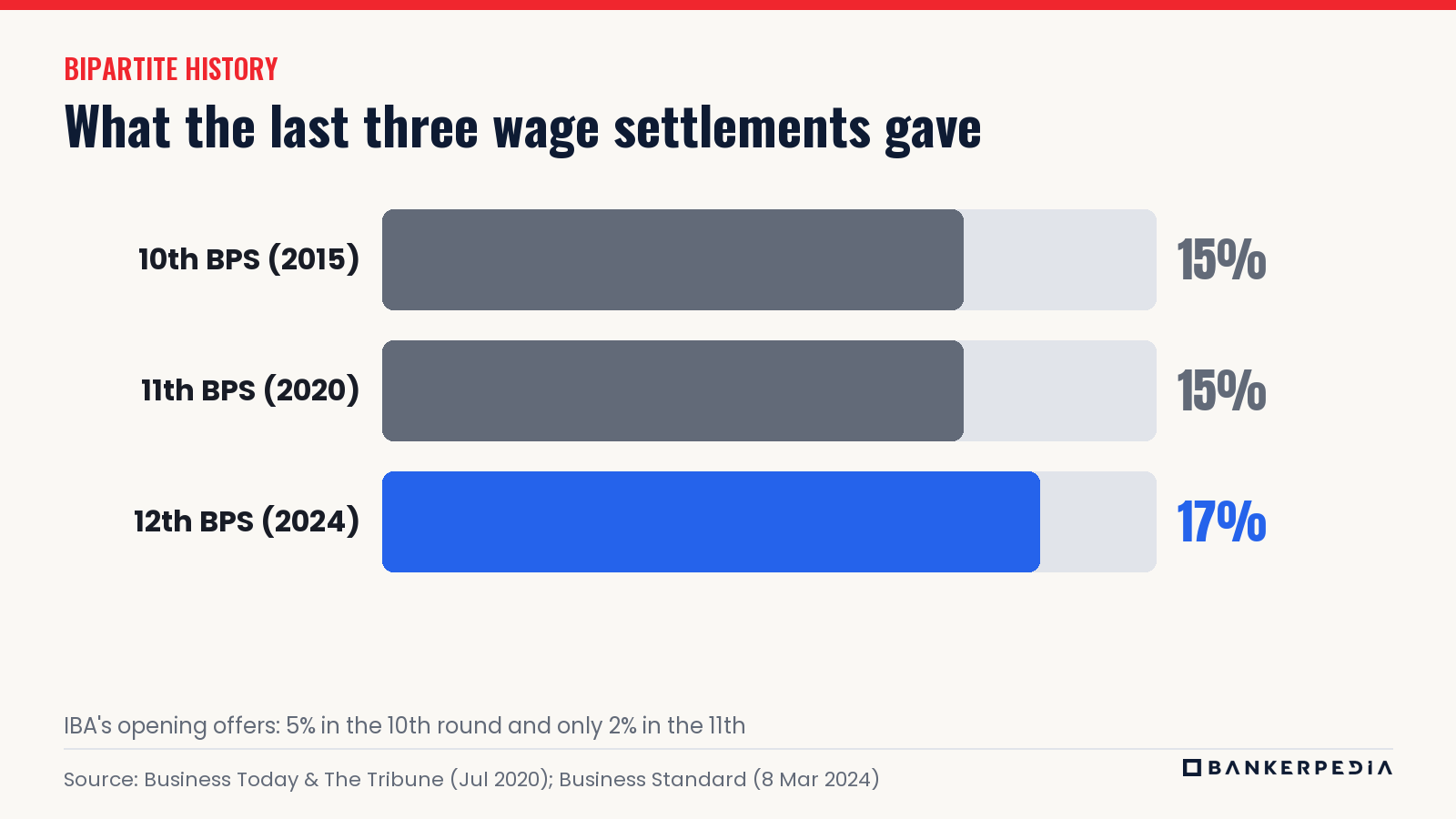
| Settlement | Signed | IBA's opening offer | Final hike |
|---|---|---|---|
| 10th BPS | 2015 | 5% [4] | 15% [4] |
| 11th BPS | 2020 | 2% [4] | 15% [4] |
| 12th BPS | 8 Mar 2024 | - | 17% [2] |
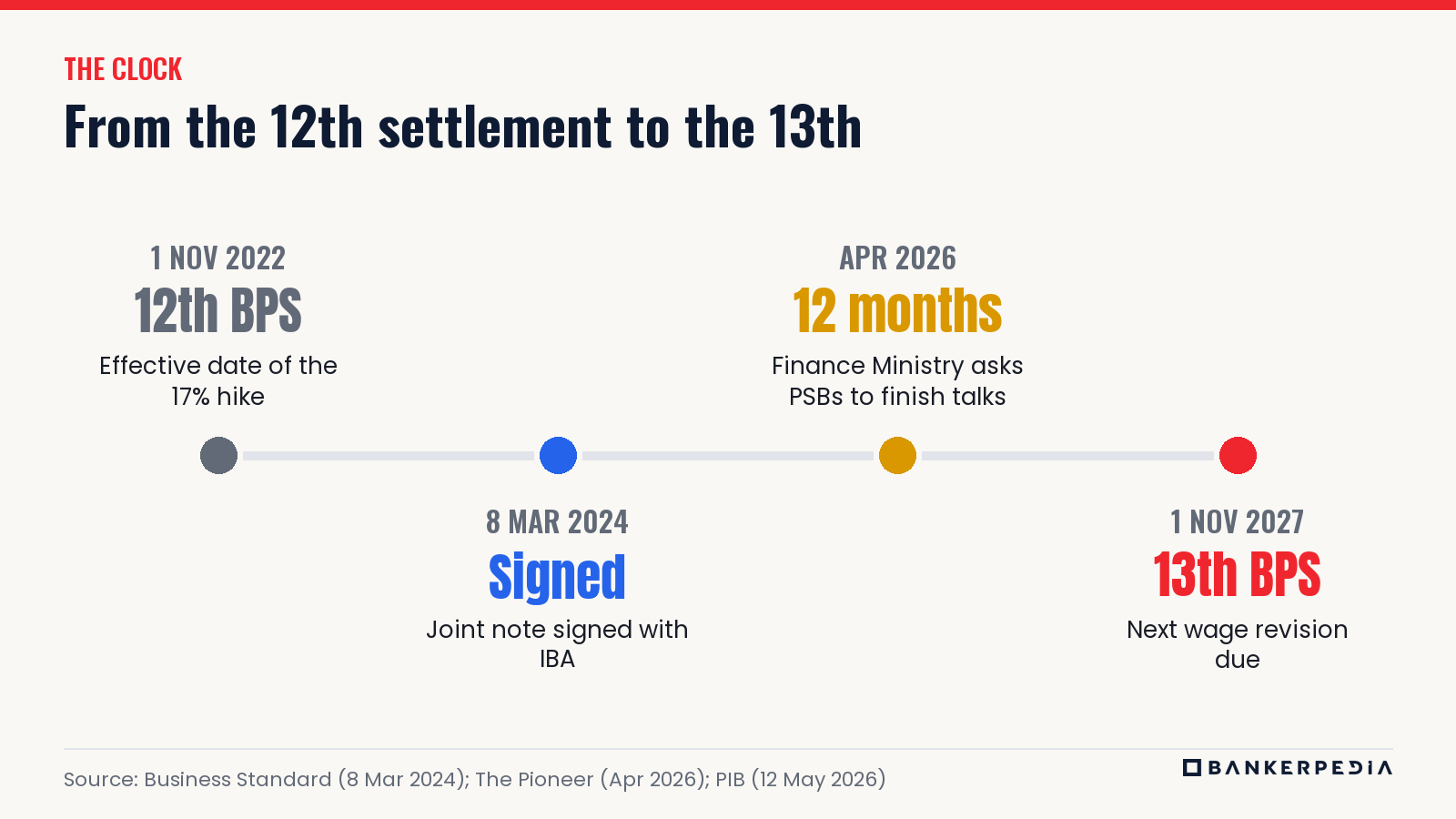
Two patterns stand out. First, the IBA's opening offer has always been far below the final deal. Second, every settlement was signed long after it fell due. The 12th settlement took effect from 1 November 2022 but was signed only in March 2024 [2], so employees waited about 16 months for arrears.
What is different in the 13th bipartite settlement
1. Record profits
Public sector banks reported a record combined net profit of ₹1.98 lakh crore in FY 2025-26 [1]. Gross NPAs fell to 1.93% and net NPAs to 0.39% [1]. A healthy balance sheet gives unions a strong argument: if banks earn more, staff should share in it.
2. A government deadline
In April 2026 the Finance Ministry asked public sector banks to finish the wage revision process within 12 months [3]. The next revision is due from 1 November 2027. If the deadline holds, this could be the first settlement in years that is not badly delayed.
3. Unions are organising early
Unions formed committees in mid-2026 to draft their charter of demands [5]. Draft lists reported in the media seek a 30 to 35% hike [5]. The UFBU also held a nationwide strike in 2026 over the five-day week, performance-linked incentives and pension issues [6].
Why the delay hurts: the cost of waiting
Late settlements are not just an inconvenience. When a settlement is signed months after it falls due, employees get the difference as arrears, but they lose the use of that money in the meantime, and the arrears are taxed in the year they are paid. A clerk or officer who retires during the wait also sees the hike reflected late in pension calculations. That is why the government's 12-month deadline [3] matters as much as the percentage itself.
Delays also shape how employees plan. Many bankers postpone home loans, children's admissions or family plans until the settlement is signed, because they cannot be sure of their future pay. A settlement that lands on time removes that uncertainty for lakhs of families.
Inside the bank: why it matters to every employee
A bipartite hike does not just raise basic pay. Dearness allowance, HRA, special allowance, overtime, and the bank's NPS contribution are all linked to basic pay. So every percentage point of the settlement flows through the whole pay slip. DA is also revised every quarter under the IBA's orders [7], which protects salaries from inflation between settlements.
Research Wing estimate: how much could the 13th BPS give?
We do not predict wage talks. But history gives a useful range. In the 10th and 11th settlements, unions finally got between 60% and 75% of what they first asked for [4][9]. If the 13th charter asks for 30 to 35%, the same pattern points to a final hike of roughly 18 to 26% [9].
The record profit [1] and the government's push for speed [3] support the upper half of that range. A slowdown in bank earnings, or a tougher IBA stance, would pull it down. Treat this as a pattern, not a forecast.
What bankers should do now
- Track your union's charter. The final demands decide the starting point for talks.
- Do not count arrears early. Plan big expenses on your current pay, not on an expected hike.
- Clear JAIIB and CAIIB. Increments for these exams compound with every future settlement.
- Keep records. Pay slips and DA orders help you check arrears when the settlement is signed.
- Read your union's circulars, not WhatsApp forwards. Wage talks attract rumours. Trust official union circulars and reputed news outlets.
Our take
The 13th bipartite settlement has the strongest tailwinds in years: record profits and a clear government deadline. The bigger win for bankers may be timing. A deal signed on time, with no long wait for arrears, is worth more than a slightly higher number that arrives two years late.
Bankers are customers too. Rate your own bank on Bankerpedia 30 so others can choose well. Aspirants can get every opening on Bankerpedia Vacancy Alert. All our data is on Bankerpedia Explore.
Video transcript
Read the full transcript
Questions people ask
What is the 13th bipartite settlement?
It is the next wage agreement between the Indian Banks' Association (IBA) and bank unions such as those in the UFBU. It will revise salaries, allowances and service conditions for public sector bank employees, and is due from 1 November 2027.
How much hike did the last bipartite settlements give?
The 10th settlement (2015) gave 15%, the 11th (2020) gave 15% after 35 rounds of talks, and the 12th (signed 8 March 2024) gave 17%.
When will the 13th bipartite settlement be signed?
In April 2026 the Finance Ministry asked public sector banks to complete the wage revision process within 12 months, so that it is not delayed like earlier rounds. The new pay is due from 1 November 2027. No signing date has been fixed.
How much will the 13th BPS salary hike be?
Nobody knows yet. Union drafts have reportedly sought 30 to 35%. History shows the IBA opens low (2% in 2018) and deals have ended between 15% and 17%. Record PSB profits of ₹1.98 lakh crore in FY26 strengthen the unions' case.
Does the 13th BPS apply to private bank employees?
No. Bipartite settlements cover public sector banks and the few private and foreign banks that have given the IBA a mandate. Most private bank employees are paid under their own bank's policies.
Sources
- PIB, Ministry of Finance: PSBs record ₹1.98 lakh crore net profit in FY 2025-26 (12 May 2026)Primary source
- Business Standard: Bank employees to get 17% annual wage hike (8 Mar 2024)
- The Pioneer: Finance ministry asks PSBs to complete wage revision process in next 12 months (Apr 2026)
- Business Today: Bank employees get 15% annual increment after 35 rounds of discussions (23 Jul 2020)
- Hellobanker: NCBE forms committee to prepare charter of demands for 13th BPS
- Business Today: Bank unions strike over 5-day week, PLI, pension (25 Aug 2026)
- IBA dearness allowance order Nov 2026 to Jan 2027, via TeamLease RegTech (2 Nov 2026)
- RBI: Report on Trend and Progress of Banking in IndiaPrimary source
- Bankerpedia Research Wing: 13th BPS estimate and method
Priya Srivastava is the Editor of Bankerpedia, where she oversees the accuracy, clarity, and editorial standards of its banking education content. She works with practising bankers to ensure every article reflects current RBI regulations, real banking practice, and the needs of exam aspirants and working professionals.
Varun Singh checked every number against its source on 28 Nov 2026. 9 sources, 2 from official sites. Read our editorial policy.
This page explains how things work. It is not personal investment, tax or legal advice. Rules change: we re-check this page against its sources and date every update. Spotted something wrong? Tell our corrections desk.
Know someone preparing for bank exams? Send them this.
Help a future banker with a page that is checked and sourced.
Send on WhatsAppBe one of the first to share this